Ant specialists — Toronto & the GTA
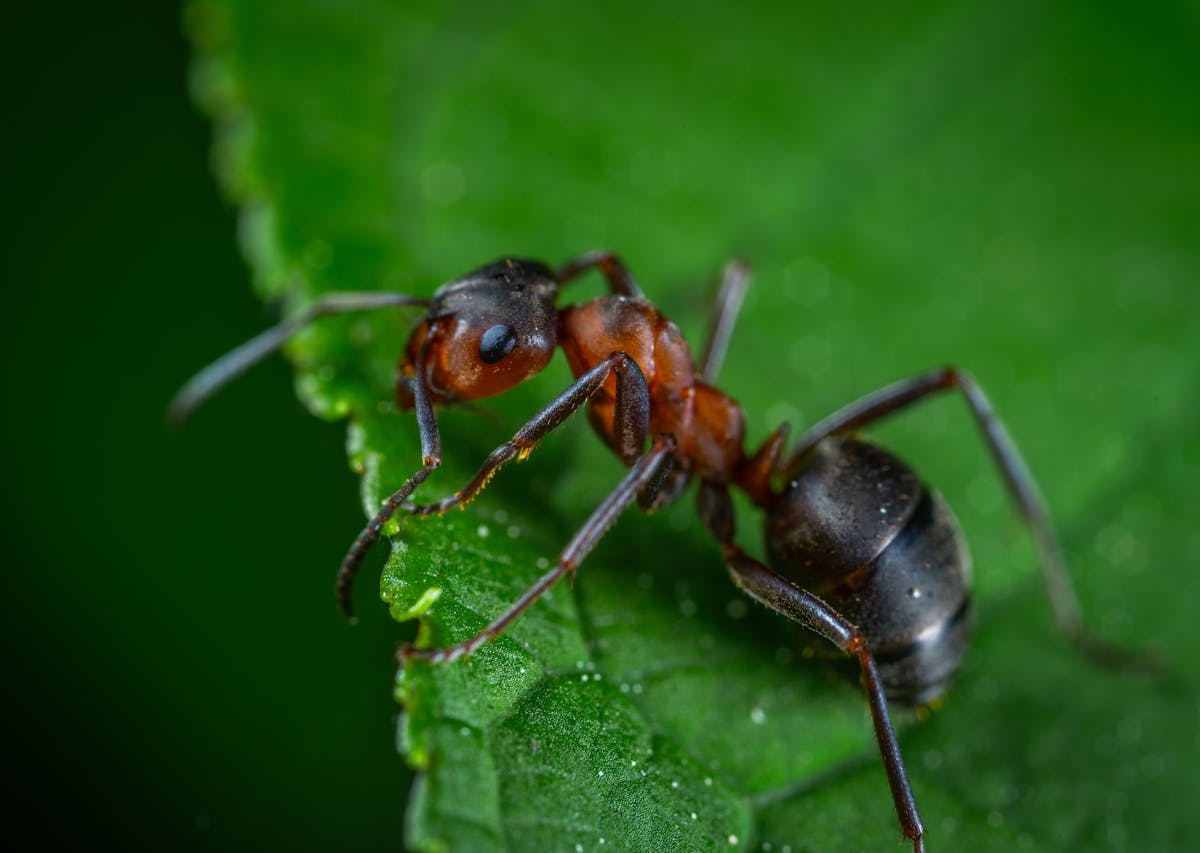
Colony-source ant control for all 14 Toronto ant species. We reach the queen and destroy the whole colony from within — with family-friendly, pet-safe options.
Eliminate ants at the source — queen included
Surface sprays only kill the ants you see — the colony survives and returns. Nomore Pest uses targeted baiting and treatment that reaches the queen and destroys the entire colony from within, for lasting results across all 14 Toronto ant species.
Complete ant treatment — inside & out
Interior, exterior, colony source and prevention.
- Kitchen counters, cabinets & pantries
- Wall voids, baseboards & insulation
- Attics, crawl spaces & basements
- Foundation perimeter & entry points
- Decks, patios & outdoor structures
- Driveways, sidewalks & garden areas
Types of ants we remove
Every species identified and treated correctly — each requires its own approach.

Black Carpenter Ant
The largest common ant in Ontario. Tunnels through damp wood to build nests, causing serious structural damage — but does not eat wood.

Pavement Ant
The most common ant seen in Toronto neighbourhoods. Builds sandy mounds in cracks and enters homes through foundation gaps.

Pharaoh Ant
Tiny ants that invade kitchens, hospitals and food businesses. One colony can split into dozens if sprayed — baiting only.

Odorous House Ant
Releases a rotten-coconut smell when crushed. Forms large trails to sweets, proteins and moisture inside homes.

Thief Ant
Tiny ants that steal food and larvae from other colonies and invade kitchens for grease and proteins. Often confused with Pharaoh ants.

Acrobat Ant
Raises its heart-shaped abdomen over its head when threatened. Nests in foam insulation, rotted wood and wall voids.

Citronella Ant
Gives off a lemon-citronella scent when disturbed. Swarms indoors during spring mating flights but poses no structural threat.

European Fire Ant
An invasive species in Ontario with a painful sting. Builds mounds in lawns and gardens and swarms when disturbed.

Field Ant
Large outdoor ants that build soil mounds near foundations and can bite when disturbed. Often mistaken for carpenter ants.

Little Black Ant
One of the smallest ants commonly found in North America, forming large indoor trails.

Cornfield Ant
Protects aphids and feeds on the honeydew they produce. Common in lawns, fields and gardens.

Argentine Ant
Forms enormous super-colonies with multiple queens — extremely difficult to eliminate without professional treatment.
How Nomore Pest eliminates ants
A 4-step colony-elimination process designed to permanently remove ants from your property.
Species ID
The correct ant species is identified and the treatment method selected based on colony behaviour.
Nest Location
Nest and entry points located inside walls, under floors and around the exterior perimeter.
Colony Elimination
Bait and residual treatments reach the queen and larvae — the entire colony destroyed at the source.
Prevention
A perimeter barrier applied, with a follow-up visit to confirm complete elimination.
Understanding ants helps us eliminate them
Ants belong to the family Formicidae, have lived on Earth for over 100 million years, and number more than 14,000 known species. Knowing how a colony works is the key to treating it properly.
Body & features
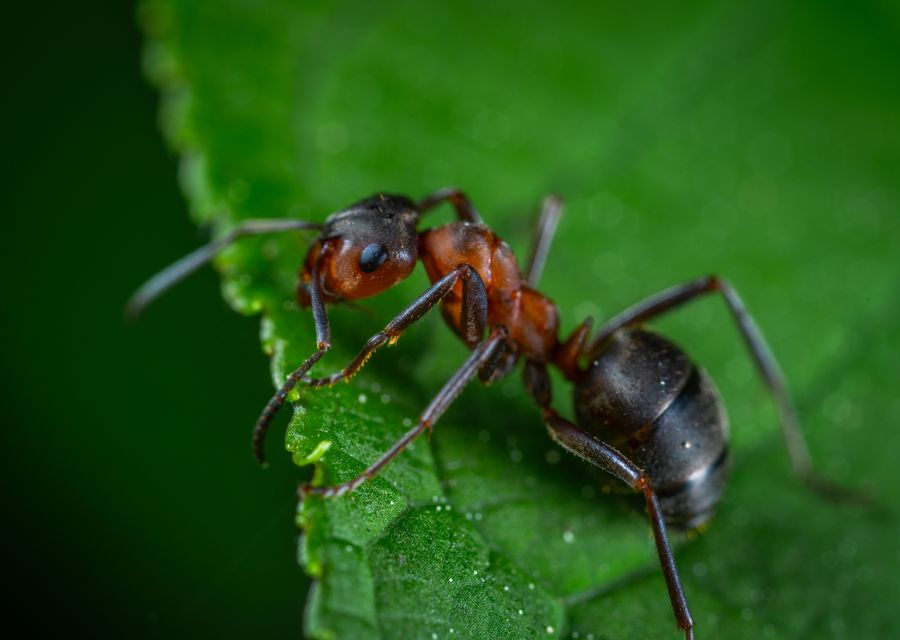
An ant has three sections — head (eyes, brain, antennae), thorax (six legs, wings on swarmers) and abdomen (organs, sometimes a stinger). Add a hard exoskeleton, bent antennae and strong mandibles.
The colony
Ants are social insects. A colony has a queen (lays eggs, can live 15–30 years), female worker ants (food, nest, young, defence), soldier ants in some species, and male drones that mate with the queen.
Life cycle
Ants go through complete metamorphosis — egg, larva, pupa, adult. Workers care for the young until they mature, which is why treating only visible ants never solves the problem.
Communication
Ants communicate mainly through pheromones — chemical trails that mark food, warn of danger and identify colony members — and by touching antennae. Breaking that trail at the source is central to control.
Across Toronto & the GTA
Same-day ant exterminator service across the GTA — ant specialists dispatched within hours.
- Toronto
- Brampton
- Mississauga
- Markham
- Vaughan
- Richmond Hill
- Scarborough
- Woodbridge
Ant control questions
Surface sprays only kill visible workers — the queen and colony survive and rebuild. We use bait that workers carry back to the nest, destroying the colony at its source.
Carpenter ants tunnel through wood to nest (they don't eat it), which still weakens beams, frames and walls over time. Fast professional treatment prevents costly structural damage.
Yes — we offer family-friendly, pet-safe options and explain exactly what's used and where before we begin.
Ants in your home or business? We eliminate the entire colony.
Same-day service · all ant species · indoor & outdoor · GTA-wide coverage.
Same-day service · Toll-free 800-461-1827 · Toronto & the GTA