You pull back the sheets and find a row of small dark spots near the seam of the mattress. Maybe you woke up with itchy red bites along your arm. Maybe you saw a flat, brown, apple-seed-sized bug crawl into the headboard. However it started, you want bed bugs gone, and you want to know which advice is worth following.
This guide covers what works against bed bugs, what wastes time and money, and how to tell when a home effort has reached its limit. It draws on guidance from Health Canada and university entomology research, plus what our technicians see in homes and apartments across Toronto and the GTA.
Quick Answer: How To Get Rid of Bed Bugs
| Step | What to do | Why it matters |
| 1. Confirm | Find a live bug, fecal spots, shed skins or eggs | Bites alone can't confirm bed bugs |
| 2. Contain | Bag bedding and clothes in sealed plastic; don't move to another room | Stops you from spreading them through the home |
| 3. Heat your fabrics | Wash hot, then dry on the hottest setting for 30+ minutes | Heat in the dryer kills all life stages |
| 4. Vacuum and steam | Vacuum seams, cracks and baseboards; steam what you can't wash | Removes bugs and eggs from hiding spots |
| 5. Encase and monitor | Zip mattress and box spring into encasements; put interceptors under bed legs | Traps bugs inside and shows whether they're still active |
| 6. Call a pro if it persists | Book a licensed exterminator for repeat sightings or multiple rooms | Hidden eggs and resistant bugs usually outlast DIY methods |
First, Make Sure It's Really Bed Bugs
Treating the wrong pest wastes weeks. Carpet beetles, bat bugs, booklice and young cockroaches are all mistaken for bed bugs, and many skin reactions look like bites. Before you start, look for at least one of these signs:
| Sign | What to look for |
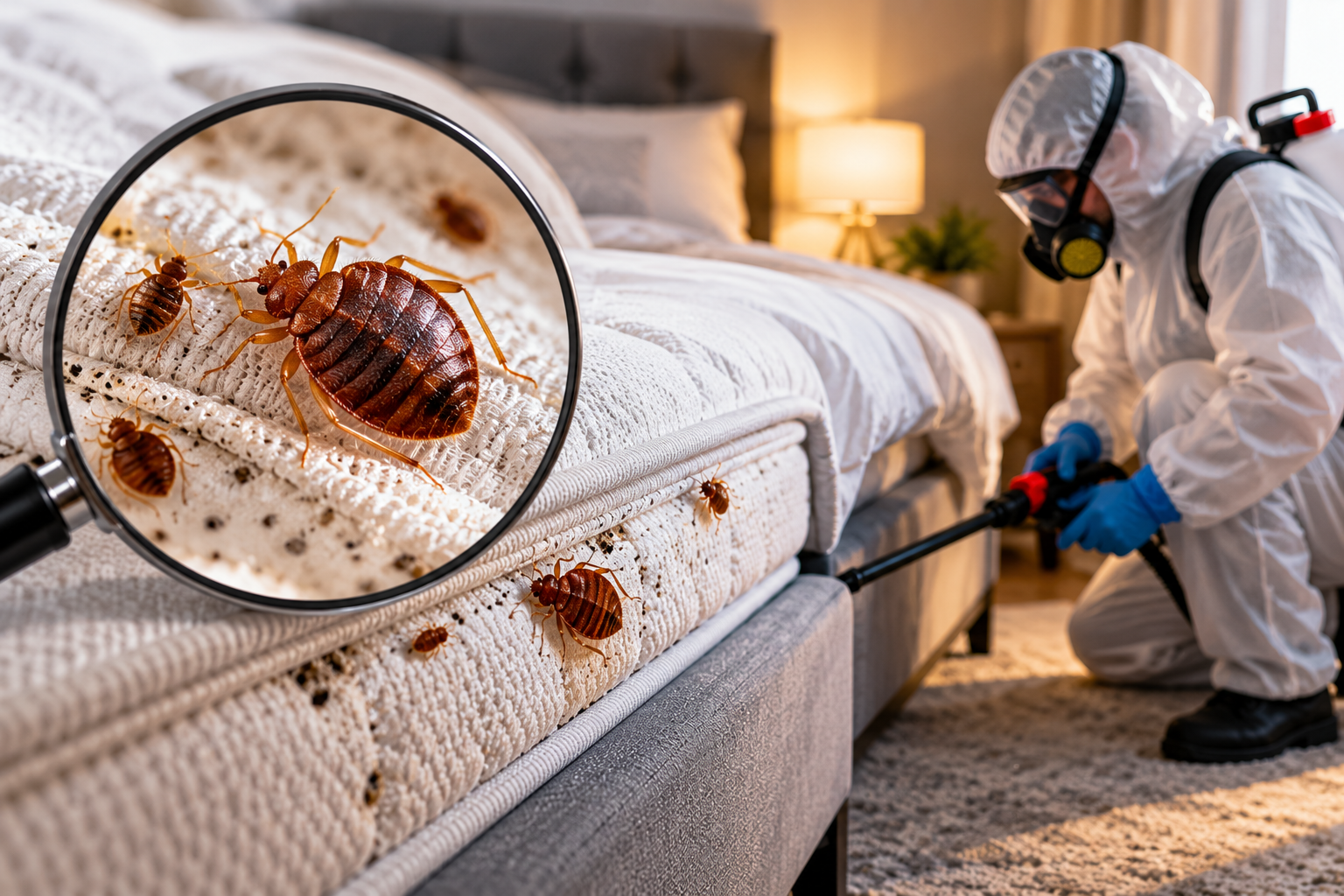
| Live bugs | Flat, oval, reddish-brown adults about 5 mm long; pale nymphs as small as a poppy seed |
| Fecal spots | Clusters of black or dark-brown dots on mattress seams, sheets and headboards that smear like ink when wiped with a damp cloth |
| Shed skins | Empty, see-through, bug-shaped casings left behind as nymphs grow |
| Eggs | Tiny pearl-white ovals, about 1 mm, stuck in seams and cracks |
| Blood smears | Small rust-coloured stains on sheets or pillowcases |
| Bites | Itchy welts, often in a line or cluster. On their own, bites are not proof, because some people never react |
Check the mattress seams and piping, the box spring, the joints of the bed frame, the headboard, nightstand drawers, the edges of carpet along the baseboards, and the seams of any couch or chair someone sleeps or naps on. A flashlight and a credit card edge help you check tight cracks.
What to Do in the First 24 Hours
The first day is when well-meaning moves make an infestation worse. Do these things:
- Keep sleeping in your bed. Moving to the couch or a guest room gives the bugs a reason to follow you and set up a second hiding area.
- Bag before you carry. Put bedding, clothing and soft items into sealed plastic bags in the room where they are, then carry the bags to the laundry.
- Don't throw out furniture yet. Most mattresses and frames can be treated. Dragging an infested mattress through hallways and stairwells spreads bugs along the way.
- Don't set off a bug bomb. Foggers don't reach where bed bugs hide (more on that below).
- Tell your landlord or property manager if you rent. Bed bugs rarely stay in one unit, and early treatment is easier for everyone.
Step 1: Contain the Infestation
Bed bugs don't fly or jump. They crawl, and they travel on the things you move. Containment means limiting where they can go and where they can hide.
- Clear clutter from around the bed and under it. Piles of clothes, books and boxes give bugs hundreds of hiding spots.
- Store cleaned items in sealed, light-coloured plastic bags or bins with tight lids. Light colours make any bug you missed easy to spot.
- Pull the bed a few centimetres away from the wall, and keep bedding from touching the floor.
- Don't lend, sell or give away items from the affected room until the problem is solved.
Step 2: Use Heat on Everything Washable
Heat is the most reliable tool you have at home. Health Canada notes that bed bugs die at 50°C, and a household dryer on high runs hotter than that.
- Wash bedding, mattress pads, curtains and infested clothing in hot water with detergent.
- Dry everything on the hottest setting the fabric allows. The dryer does more of the work than the wash.
- Put dry-clean-only and other non-washable items (shoes, stuffed toys, backpacks) in a hot dryer for at least 30 minutes.
- Don't overload the dryer. Heat has to reach the middle of the load.
Laundry protects your clothes and bedding, but it doesn't treat the bed, the furniture or the room itself.
Step 3: Vacuum Every Day, the Right Way
Vacuuming pulls up bugs, eggs and shed skins from places sprays don't reach. It won't get everything, but it lowers the numbers fast.
- Use a crevice nozzle on mattress seams, box spring corners, bed frame joints, baseboards, carpet edges, drawer interiors and furniture seams.
- On mattresses, use a stiff brush attachment with a back-and-forth motion to loosen eggs.
- Avoid handheld vacuums and models with cloth bags or fabric hoses, which can become infested themselves.
- When you're done, seal the vacuum bag in a plastic bag and put it in a lidded outdoor bin. For a bagless vacuum, empty the canister into a plastic bag, seal it, throw it out, and wash the canister in hot, soapy water.
Step 4: Steam What You Can't Wash
A good steamer reaches 100°C or more at the tip, which kills bed bugs and eggs on contact. Use it on mattresses, upholstered furniture, bed frames and other items that won't fit in a dryer.
- Move the nozzle slowly so the heat gets deep into seams and folds.
- Use a dry or low-vapour steamer and avoid soaking fabrics, which can lead to mould.
- Steam first, then vacuum, so you pick up anything the steam flushes out.
- Avoid strong airflow attachments that blow bugs out of cracks instead of killing them.
Steam only kills what it touches. Bed bugs deep inside wall voids, outlets and furniture joints can survive it.
Step 5: Encase the Mattress and Monitor With Interceptors
Mattress and box spring encasements are zippered covers designed for bed bugs. Once they're zipped shut, any bugs inside can't get out to feed and eventually die. The smooth surface also makes new bugs easier to spot. Leave the encasements on for at least a year, because bed bugs can live for months without feeding. Encasements protect the mattress, but they don't stop bugs living in the frame or headboard from reaching you.
Interceptor traps are small dishes that go under each bed leg. Bugs climbing up fall in and can't climb the slick inner wall. They won't wipe out an infestation, but they tell you whether bugs are still active. That makes them one of the best ways to judge whether a treatment worked. Check them at least once a week.
Step 6: If You Use a Product, Use the Right One
If you buy an insecticide, make sure it's registered in Canada for bed bugs. Registered products show a Pest Control Products (PCP) number on the label. Then follow the label exactly.
- Never spray a product on people, pets or bedding unless the label specifically allows it.
- Don't use pesticides on cribs, playpens or children's toys.
- Don't make homemade pesticides. They can be dangerous to mix and use.
- Expect limited results from store-bought sprays. Many bed bug populations have developed resistance to common insecticides, and contact sprays only kill the bugs they hit.
Step 7: Keep Watching for Several Weeks
Eggs that survive your first round will hatch, and those young bugs need time to show up. Keep vacuuming, keep checking interceptors and keep an eye on the sheets. If you still find live bugs, fresh fecal spots or new bites after several weeks of steady effort, the infestation is bigger than a home treatment can handle.
What Doesn't Work and Can Make Things Worse
Search results and social media are full of quick fixes. Most of them either don't kill bed bugs where they hide or create new risks.
| Method | Does it work? | Why |
| Bug bombs / foggers | No | A 2012 Ohio State University study found three over-the-counter foggers had little or no effect on field-collected bed bugs. The mist doesn't reach cracks and seams, and foggers are a fire and health hazard when misused. |
| Rubbing alcohol | Not recommended | It only kills bugs it soaks directly, evaporates quickly, misses eggs in hiding, and is highly flammable, so spraying it around a bedroom is a real fire risk. |
| Bleach | Not recommended | Not designed or registered for bed bug control, damages fabrics and surfaces, and doesn't reach hiding places. |
| Household disinfectant sprays | Not reliable | Disinfectants target germs, not insects. At best they hit the few bugs you can see. |
| Putting things outside in winter | Unreliable | Health Canada says freezing needs a steady −19°C for four days in a row and may still miss some bugs. A Toronto winter rarely stays that cold, day and night, for four straight days, and a garage or porch usually stays warmer. |
| Diatomaceous earth alone | Slow and limited | Entomologists at the University of Kentucky note it seldom eliminates an infestation by itself. Never use pool-grade product, which is harmful to breathe. |
| Ozone generators | No | No ozone device is approved for bed bugs in Canada, and Health Canada warns they can cause breathing problems and eye, nose and throat irritation. |
| Throwing out the bed | Rarely needed | The bugs are also in the frame, furniture and room. A new mattress in an untreated room gets infested again. |
How to Dispose of Bed Bug-Infested Items
Sometimes an item is too damaged or too heavily infested to save. If you decide to throw something out, do it in a way that doesn't hand the problem to someone else:
- Wrap mattresses, box springs and upholstered furniture completely in heavy plastic and tape the seams before moving them.
- Mark the item clearly as infested with bed bugs so nobody takes it home from the curb.
- Move it straight out of the home on collection day instead of storing it in a hallway, garage or shared storage room.
- Seal small items in plastic bags and put them in a lidded outdoor bin.
Treat the room before you bring in replacement furniture. Otherwise the new bed becomes the next hiding spot.
How Long Does It Take to Get Rid of Bed Bugs?
It depends on how long the bugs have been there, how many rooms are involved, and how much clutter they can hide in. A small infestation caught early and handled by a professional is often under control within a few weeks. Larger or long-standing infestations, and those in multi-unit buildings, usually need more than one visit because eggs hatch after the first treatment.
Patience matters here. Bed bugs can survive for months without a meal, so a quiet week doesn't mean they're gone. Keep monitoring until several weeks pass with no new signs.
Bed Bugs in Apartments and Condos
In multi-unit buildings, bed bugs move between units through wall voids, shared laundry rooms, hallways and furniture left in common areas. That's why treating only one unit often fails.
- Tenants: tell your landlord or property manager in writing as soon as you find signs. In Ontario, landlords are responsible for keeping units fit to live in, and public health guidance says that includes arranging pest control. Tenants are expected to prepare their unit as instructed before treatment.
- Landlords and property managers: inspect neighbouring units, not just the one that reported. Catching a spread early is far cheaper than treating a whole floor later.
If a landlord doesn't respond, Ontario tenants can contact a community legal clinic or the Landlord and Tenant Board for help.
When to Call a Professional
Home methods can help with a small, early problem, but they rarely reach every egg. Call a licensed exterminator if any of these apply:
- You're still finding live bugs or new bites after a few weeks of DIY effort
- You've seen signs in more than one room or on furniture beyond the bed
- You live in an apartment, condo or townhouse with shared walls
- Someone in the home is reacting badly to bites or losing sleep
- You run a rental, short-term rental or business where guests sleep
- You've already tried sprays or foggers and the problem has spread
Health Canada strongly recommends hiring a licensed pest control professional for bed bugs. Professionals can use methods that homeowners can't, such as commercial insecticides and dusts, carbon dioxide snow, and steam or heat systems, and they know where bed bugs hide.
How Nomore Pest Gets Rid of Bed Bugs
Our licensed technicians handle bed bugs in houses, apartments, condos and commercial properties across Toronto, Mississauga, Vaughan, Scarborough, North York and Etobicoke. Every job follows the same steps:
- Inspection. We confirm it's bed bugs, find where they're hiding and check how far they've spread.
- Preparation checklist. You get clear instructions for laundry, decluttering and furniture so the treatment reaches everywhere it needs to.
- Treatment. We use proven bio and chemical treatments that target every life stage, including eggs, applied to the bed, furniture, cracks and baseboards.
- Follow-up. A follow-up inspection is built into every plan to confirm the infestation is gone.
If you're seeing signs of bed bugs, book a bed bug inspection with our Toronto team. Inspections are free, and we'll tell you honestly whether you need treatment.
Conclusion
Getting rid of bed bugs comes down to confirming the problem, stopping the spread, using heat where you can, and monitoring until the signs stop. Skip the bug bombs, alcohol and bleach. If live bugs keep showing up after a few weeks, or you're in a shared building, bring in a professional before the infestation reaches more rooms.
Need help now? Call Nomore Pest at 800-461-1827 or 437-922-2705, or email info@nomorepest.ca for a free bed bug inspection anywhere in Toronto and the GTA.
Frequently asked questions
What kills bed bugs instantly?
Direct heat. Steam at 100°C or more kills bed bugs and eggs on contact, and a clothes dryer on its hottest setting kills them in fabrics. Contact sprays only kill the bugs they hit, and none of these reach bugs hiding deep in cracks, which is why one-time fixes rarely end an infestation.
Can you get rid of bed bugs on your own?
Sometimes, if the infestation is small and caught early. Laundering on high heat, vacuuming, steaming, mattress encasements and interceptors can bring numbers down. If you still see live bugs or new bites after a few weeks, or you live in a building with shared walls, a licensed exterminator is the faster and more reliable option.
Does the dryer kill bed bugs?
Yes. Drying clothes and bedding on the hottest setting kills bed bugs and their eggs. Health Canada recommends at least 30 minutes in a hot dryer for items you can't wash. Don't overload the machine, so the heat reaches the middle of the load.
Will a Canadian winter kill bed bugs?
Not reliably. Health Canada says freezing needs a steady −19°C for four days in a row, and even that may not kill every bug. Bed bugs live indoors where it's heated, so a cold snap outside doesn't affect them, and items left in a garage or on a porch usually don't stay cold enough.
Should I throw out my mattress if I have bed bugs?
Usually not. Most mattresses can be treated and then sealed in a bed bug encasement, which traps any bugs inside until they die. Throwing out the mattress doesn't remove the bugs living in the bed frame, furniture and room, and carrying it out can spread them.
Do bug bombs kill bed bugs?
No. A 2012 Ohio State University study found over-the-counter foggers had little or no effect on bed bugs, because the mist doesn't reach the cracks and seams where they hide. Foggers can also scatter bugs and are a fire and health hazard when misused.
How long can bed bugs live without feeding?
Months. University of Kentucky entomologists report that nymphs and adults can go months without a meal, and in cool conditions possibly a year or more. That's why leaving a room empty for a few weeks won't starve them out.
Got a pest problem? Don't wait.
Book a professional inspection across Toronto & the GTA and get peace of mind, backed by a licensed & insured local team.
Or email us at info@nomorepest.ca · Toronto & the GTA