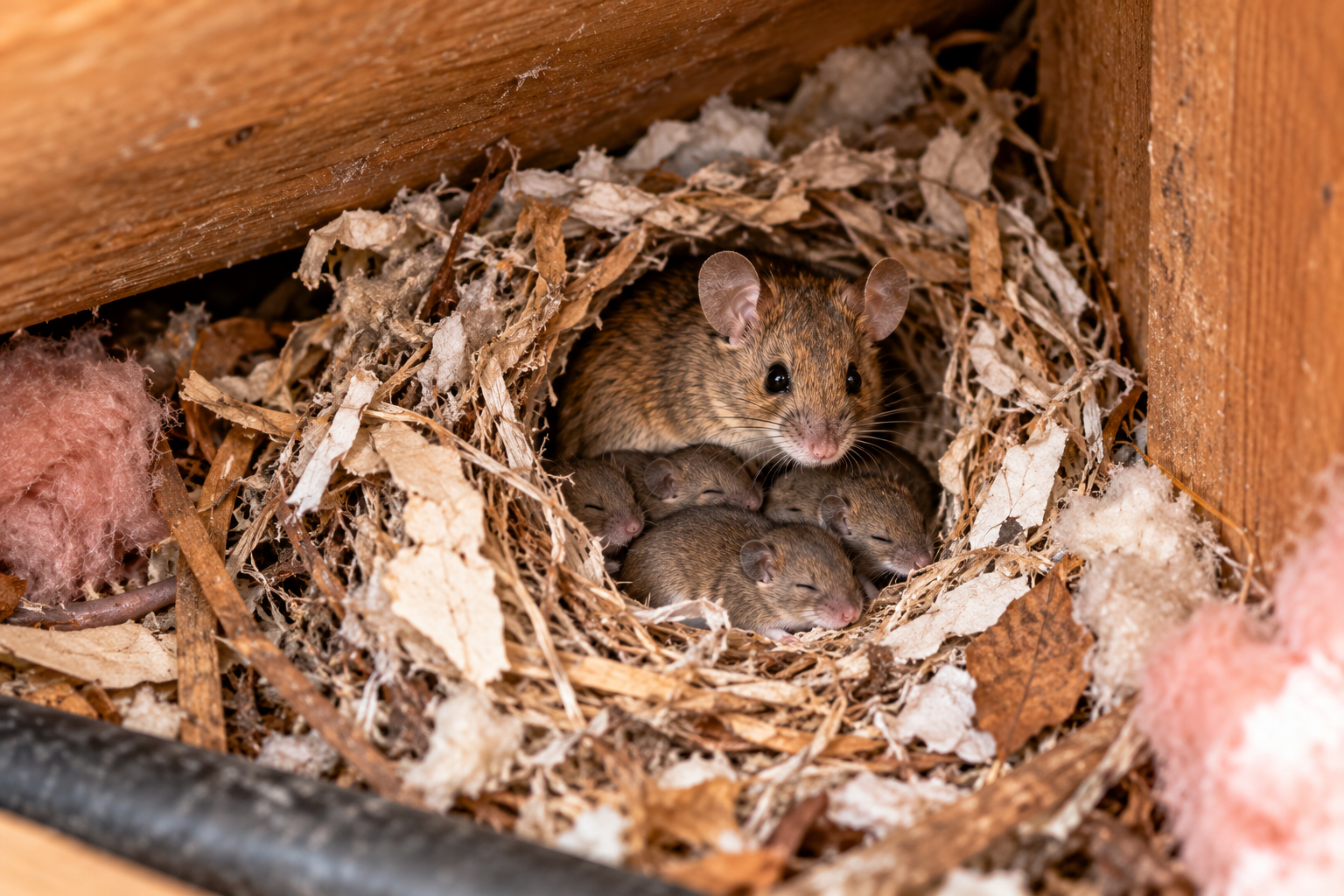
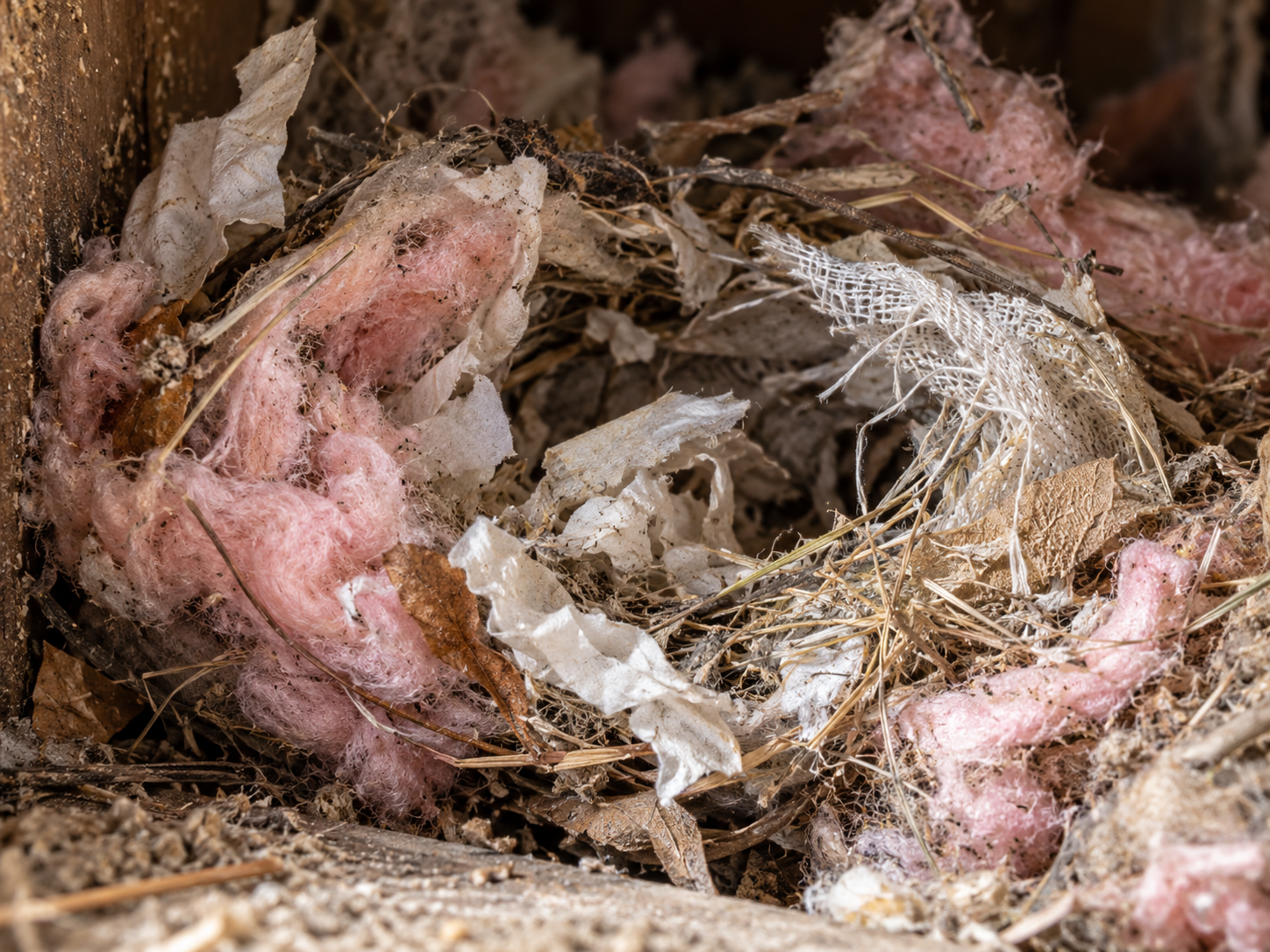
A mouse nest doesn't look like a bird's nest. It looks like a messy ball of shredded material — paper, insulation, fabric, cardboard tucked into a dark corner where nobody goes.
Finding one matters more than finding droppings. Droppings mean mice have passed through. A nest means they've settled in and are breeding. Here's how to recognise one, where to look, and what to do next.
Mouse nest at a glance
| Feature | What to look for |
| Shape | A loose, rounded ball with a hollow centre, often flattened into a corner |
| Size | Roughly 10–15 cm across — about the size of a grapefruit |
| Material | Shredded paper, cardboard, insulation, fabric, dryer lint, pet hair, string, foam |
| Location | Dark, quiet, enclosed spots within a few metres of food |
| Nearby signs | Heavy droppings, urine smell, grease marks, squeaking sounds |
| Who lives in it | Usually a female and her young, sometimes a small family group |
What Does a Mouse Nest Look Like?
Mice build nests from whatever soft material they can find and chew up. A typical nest is:
- A loose ball of shredded material, not woven or neatly built
- About 10–15 cm across, though nests squeezed into a wall cavity or behind an appliance can be flatter and wider
- Hollow in the middle, with a cup-shaped space where the mice sit
- Made of mixed materials — you'll often see several colours and textures in one nest: pink or yellow insulation, shredded newspaper, cardboard fibres, fabric threads, cotton, dryer lint and even plant material
- Surrounded by droppings and a strong, musty, ammonia-like smell
If the nest is active, you may also see small, dark droppings right in and around it, and the material will look fresh rather than dusty.
What mice use to build nests
Mice shred almost any soft material:
| Common nesting materials | Where they get them |
| Paper, newspaper, cardboard | Storage boxes, recycling, stored documents |
| Insulation | Attics, wall cavities, around pipes and ducts |
| Fabric, cotton, upholstery stuffing | Stored clothing, old furniture, soft toys |
| Dryer lint and pet hair | Laundry rooms, pet bedding |
| String, twine, dental floss | Drawers, garages, sheds |
| Foam and seat padding | Stored furniture, cars, machinery |
This is also a prevention clue: cardboard boxes and piles of paper in a basement or garage are an open invitation. Plastic bins with tight lids aren't.
Where Do Mice Build Nests?
Mice nest somewhere dark, quiet, enclosed and close to food — usually within a few metres of a food source. The most common spots in GTA homes:
- Inside wall cavities, especially near the kitchen or heating ducts see mice in walls
- In attic insulation, one of the most common spots in a house
- Behind and underneath appliances — the fridge, stove, dishwasher and washing machine all give off warmth
- In the back of lower kitchen cupboards and the pantry
- In storage boxes, especially cardboard ones full of paper or fabric
- In basement corners, near the furnace and water heater
- In the garage or shed, among stored items
- Inside stored furniture, couches and mattresses
- In vehicles that don't move often — engine bays, air filter housings and under seats
- In drawers you rarely open
How Many Mice Live in a Nest?
A nest usually holds one female and her young — typically five or six, sometimes more. Mice are social, so you may also find small groups sharing a nest, and a single home can have several nests at once.
That's the important part: a nest is not one mouse. A female can have around five to ten litters a year, and her young can breed from about six weeks old — so a nest found in October can represent a much bigger population by winter.
Also Read: Types of Mice in Ontario
How to Find a Mouse Nest
Mice hide nests well, but they leave a trail:
- Follow the droppings. Droppings get heavier the closer you are to a nest see what mouse poop looks like).
- Follow the smell. A strong musty, ammonia-like smell in one cupboard, room or corner usually means a nest is nearby.
- Look for grease marks — dark smudges along walls and around holes where mice travel the same route every night.
- Listen at night. Scratching, rustling and faint squeaking from one spot points to the nest area.
- Check the obvious hiding places — behind and under appliances, inside lower cupboards, in stored boxes, in the attic and along basement walls.
- Look for shredded material. A trail of chewed paper, insulation or fabric usually leads back to the nest.
Is It a Mouse Nest or Something Else?
| Nest type | How to tell |
| Mouse nest | Ball of finely shredded material, 10–15 cm, small droppings (3–6 mm) around it |
| Rat nest | Larger, often in burrows outside, in basements or under decks; droppings 12–20 mm see mouse vs rat |
| Squirrel nest | Much bigger, usually in the attic, made of leaves, twigs and coarse insulation |
| Bird nest | Twigs and grass, usually in vents, soffits or chimneys |
| Wasp nest | Papery, grey, layered not soft or shredded |
Found a Mouse Nest? What to Do
1. Don't disturb it dry
Never sweep or vacuum a nest, droppings or the surrounding area. Dried droppings and urine break into particles that can be breathed in.
2. Deal with the mice, not just the nest
Removing a nest on its own doesn't solve anything — the mice simply rebuild somewhere else in the same house, often somewhere harder to reach. Set traps along walls near the nest and the routes leading to it before or at the same time as you clear it see the best mouse traps and bait.
3. If there are young in the nest
Hairless or furred young mean an active breeding site and an adult female close by. Wear gloves, don't handle them bare-handed, and deal with the adults as well — otherwise she'll simply nest again nearby. If you'd rather not handle it, this is a good point to call a professional.
4. Remove it safely
- Open windows and air out the area for at least 30 minutes
- Wear gloves, and a well-fitting mask in enclosed spaces like attics and crawl spaces
- Spray the nest and surrounding area with disinfectant or a diluted bleach solution and let it soak for several minutes
- Pick it up with a plastic bag turned inside out, double-bag it and put it in the outdoor bin
- Disinfect the whole area afterwards and wash your hands thoroughly
Full instructions are in how to clean up mouse droppings safely.
5. Replace contaminated material
Insulation, cardboard and fabric that mice have nested in should be bagged and thrown out rather than cleaned. In an attic, soiled insulation often needs to be removed and replaced.
6. Close the way in
Once the mice are gone, seal the gaps they used — otherwise new mice move in and build a new nest. See how mice get into your house.
How to Stop Mice Nesting in Your Home
- Swap cardboard storage boxes for sealed plastic bins
- Clear out piles of paper, fabric, old bedding and packaging
- Keep stored items off the floor and away from walls
- Store pet food and birdseed in sealed containers
- Clean behind and under appliances regularly
- Seal entry points before the fall, when mice come indoors see how to keep mice out of your house
When to Call a Professional
Finding a nest is one of the clearest signs that a problem is established rather than passing through. Call a professional if:
- The nest is in a wall, ceiling or attic insulation
- There are young mice in it
- You've found more than one nest
- You keep finding fresh nesting material after clearing it
- There's a strong smell or heavy contamination
- You'd rather not handle the nest or the clean-up yourself
How Nomore Pest Handles It
Nomore Pest is a licensed and insured pest control company serving Toronto, Mississauga, Vaughan, Scarborough, North York and Etobicoke. We locate nests including in walls and attic insulation — remove the mice, clean and sanitise the area with the right protective equipment, and seal the entry points so a new nest doesn't appear next month. Learn more about our mouse control and nest removal services.
Found a nest? Book an inspection or call 800-461-1827 / 437-922-2705. You can also email info@nomorepest.ca.
Conclusion
A mouse nest is a grapefruit-sized ball of shredded paper, insulation and fabric, hidden somewhere dark and close to food, with droppings and a musty smell around it. Finding one means mice are breeding in your home, not just visiting. Trap the mice, remove the nest safely without sweeping or vacuuming, replace contaminated insulation, and seal the gaps they came in through. The full plan is in our complete guide to getting rid of mice humanely or Nomore Pest's rodent team can find the nests you can't reach and deal with the whole population.
Frequently asked questions
What does a mouse nest look like?
A mouse nest looks like a loose ball of shredded paper, insulation, fabric and other soft material, roughly 10–15 cm across, with a hollow centre. It's usually tucked into a dark, enclosed space and surrounded by droppings and a musty smell.
Where do mice build their nests?
In dark, quiet places close to food — inside wall cavities, in attic insulation, behind and under appliances, at the back of lower cupboards, in storage boxes, in basements and garages, and sometimes inside parked vehicles.
How many mice live in one nest?
Usually a female and her young about five or six, sometimes more. Mice are social and may share nests, and one home can have several nests at the same time.
Should I remove a mouse nest myself?
You can, if it's accessible and you take precautions: ventilate the area, wear gloves, wet the nest with disinfectant before touching it, double-bag it for the outdoor bin, and never sweep or vacuum. Nests in walls, attics or with young inside are better handled by a professional.
Will mice come back if I remove the nest?
Yes, if the mice themselves are still in the house or can still get in. Removing a nest without trapping the mice and sealing entry points usually just means they build a new nest somewhere else.
What's the difference between a mouse nest and a rat nest?
Mouse nests are smaller balls of finely shredded material with small 3–6 mm droppings nearby. Rat nests are larger, often in burrows outdoors or in basements and under decks, with droppings around 12–20 mm.
Does finding a nest mean I have an infestation?
It usually does. A nest means mice have settled and are breeding rather than just passing through, so it should be treated as an active infestation.
Got a pest problem? Don't wait.
Book a professional inspection across Toronto & the GTA and get peace of mind, backed by a licensed & insured local team.
Or email us at info@nomorepest.ca · Toronto & the GTA