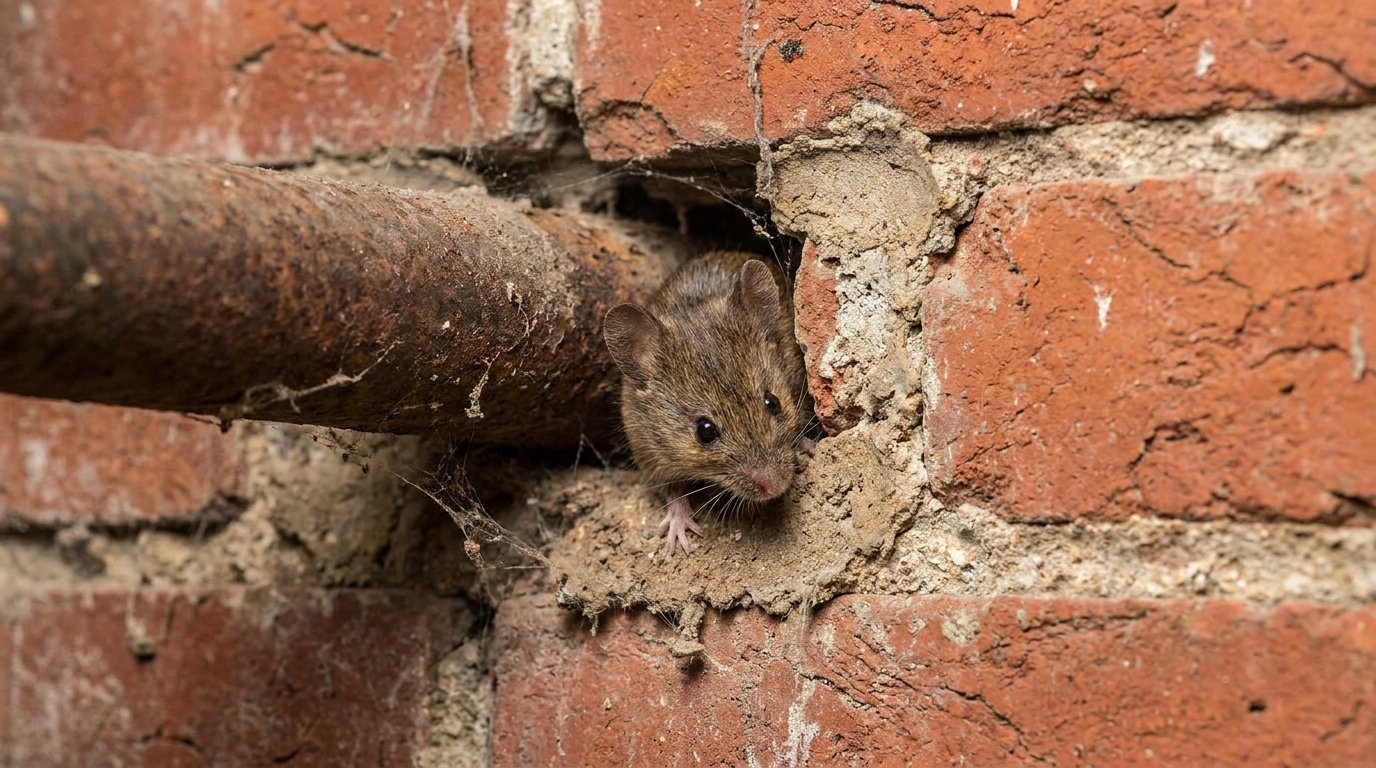
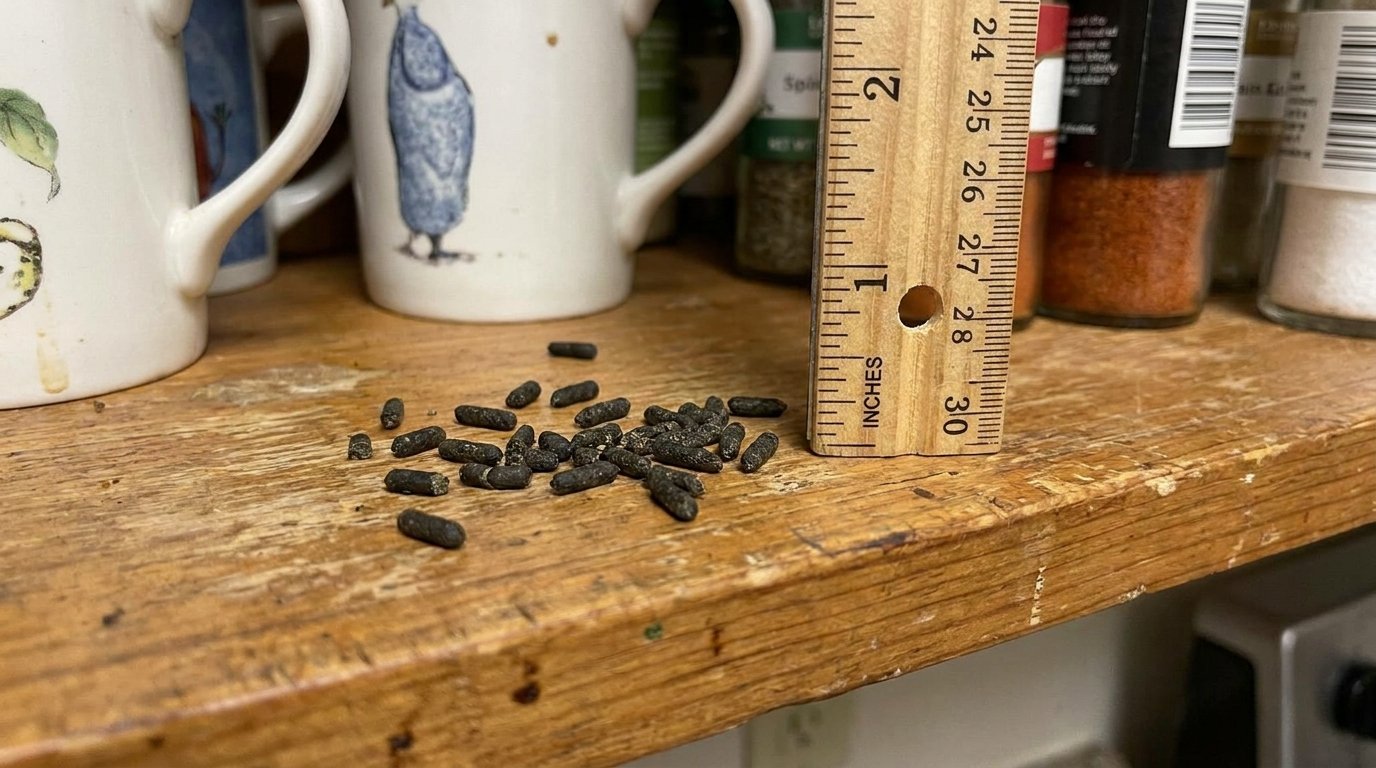
Small dark pellets in the cutlery drawer. A few specks behind the toaster. A scattering along the basement wall. Droppings are usually the first sign of mice in a home — often long before you see a mouse.
This guide shows you exactly what mouse poop looks like, how to tell fresh droppings from old ones, and how to tell mouse droppings apart from rat, bat and cockroach droppings. It also covers what finding them means and what to do next.
Mouse poop:
| Feature | Mouse droppings |
| Size | About 3–6 mm long — roughly the size of a grain of rice |
| Shape | Thin, rod-shaped, with pointed ends |
| Colour | Dark brown to black when fresh; greyish and dull when old |
| Texture | Soft, moist and shiny when fresh; dry and hard when old |
| Amount | Scattered in large numbers — one mouse can leave dozens a day |
| Where | Along walls, in drawers and cupboards, under sinks, behind appliances |
What Does Mouse Poop Look Like?
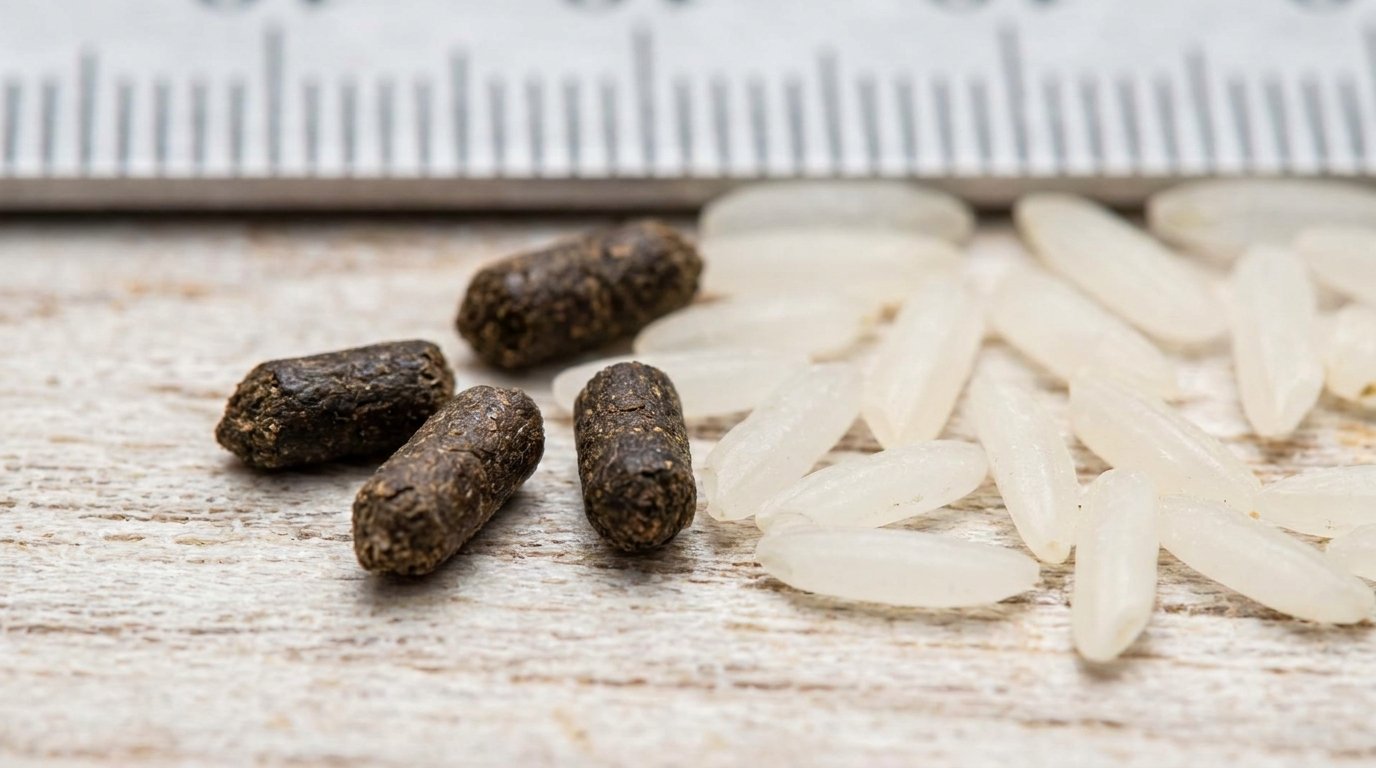
Mouse droppings look like small, dark grains of rice with pointed ends. Here's what to check:
- Size: Most mouse droppings are 3–6 mm long. That's small enough that people often mistake them for dirt, seeds or black pepper at first glance.
- Shape: They are narrow and rod-shaped, often slightly curved, with one or both ends pointed.
- Colour: Fresh droppings are dark brown to black. They fade to a dull grey-brown as they dry out.
- Pattern: Mice don't use one spot as a toilet. They drop pellets as they move, so you'll see droppings scattered along the routes they travel rather than in one neat pile.
Deer mice, which are common around Ontario homes, cottages, garages and sheds, leave droppings that look almost the same as house mouse droppings. You can't reliably tell the two species apart from droppings alone — which matters, because deer mice are the main carrier of hantavirus in Canada. Treat all mouse droppings with the same care (see how to clean up mouse droppings safely).
Mouse Poop Pictures: What to Compare
When you compare what you've found with mouse poop pictures online, keep three things in mind:
- Check the scale. Many photos are close-ups that make droppings look bigger than they are. Compare what you've found with a ruler or a grain of rice, not with the photo size.
- Look at the ends. Pointed ends suggest mice. Blunt, rounded ends on bigger droppings suggest rats.
- Look at the number and pattern. Many small, scattered pellets along a wall point to mice. A few large droppings in a group point to rats.
If you still aren't sure, take a clear photo next to a ruler (don't touch the droppings) and a pest professional can usually identify it from that.
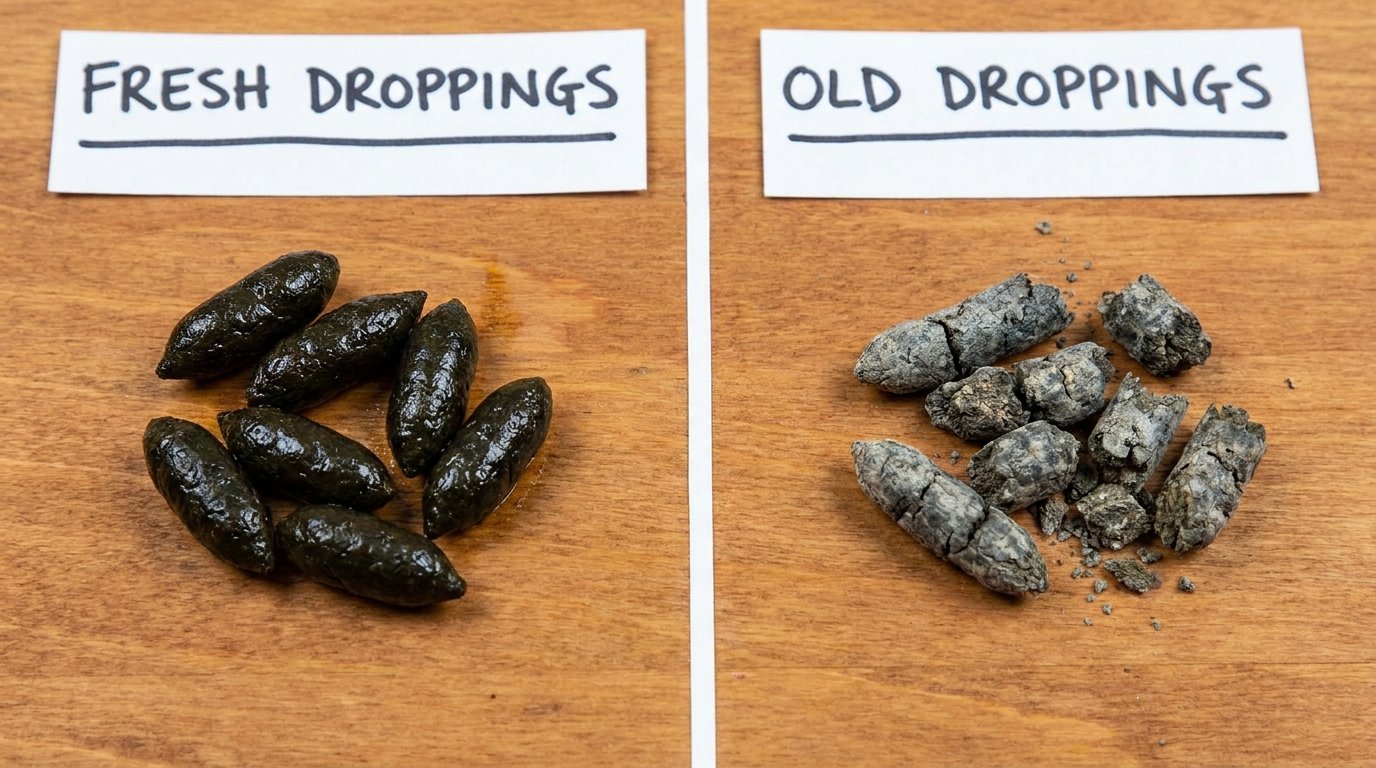
Fresh vs Old Mouse Droppings: Is the Infestation Active?
The age of the droppings tells you whether you have a current problem or old evidence from a past one.
| Fresh droppings | Old droppings |
| Black or very dark brown | Grey, faded or dusty |
| Shiny and moist-looking | Dull and dry |
| Soft, putty-like | Hard; may crumble if disturbed |
| Found in areas you recently cleaned | Found in undisturbed places like old storage boxes or insulation |
The simple test: Safely clean up the droppings in one area (follow the clean-up steps later in this guide), then check the same spot one to two days later. If new droppings appear, the mice are active right now.
Where You'll Find Mouse Droppings — and What It Tells You
Mice leave droppings where they feed, travel and nest. The location helps you figure out how big the problem is and where the mice are coming from.
| Where you find droppings | What it usually means |
| Kitchen drawers, pantry and cupboards | Mice are feeding on your food — check packaging for gnaw marks |
| Under the sink or behind the stove and fridge | Mice are using gaps around pipes and appliances as travel routes |
| Along baseboards and basement walls | These are the "highways" mice use — a good place for traps |
| Inside the attic, in insulation or in wall voids | Mice may be nesting in the structure — harder to treat with DIY |
| In the garage, shed or storage boxes | A common first stop before mice move into the house |
| In a small cluster with shredded paper or fabric | You may be near a nest (see what a mouse nest looks like) |
Droppings in several rooms or on more than one floor usually mean more than one or two mice. Mice breed quickly, so a small number of droppings can turn into a much bigger problem within weeks — read how fast mice breed.
If you're finding droppings inside walls or hearing scratching but can't see anything, see our guide to mice in walls.
How Many Droppings Does a Mouse Leave?
A single mouse can leave dozens of droppings every day — figures of 50 or more are often quoted. That's why even a small mouse problem can look dramatic. It also means the number of droppings alone isn't a reliable count of how many mice you have. The spread matters more: droppings in several separate areas are a better sign of a larger population than a heavy pile in one spot.
Mouse Poop vs Rat Poop: How to Tell the Difference
This is the most common question people ask after finding droppings, and it matters, because mice and rats need different treatment. Size is the biggest clue.
| Feature | Mouse droppings | Rat droppings |
| Length | About 3–6 mm | About 12–20 mm |
| Size comparison | Grain of rice | Olive pit or large raisin |
| Shape | Thin, with pointed ends | Thicker, capsule- or spindle-shaped |
| Ends | Pointed | Blunt (Norway rat) or pointed (roof rat) |
| Pattern | Many small pellets, scattered widely | Fewer, larger droppings, often in groups |
| Common locations | Drawers, cupboards, behind appliances, along walls | Basements, along foundations, garages, near burrows and garbage |
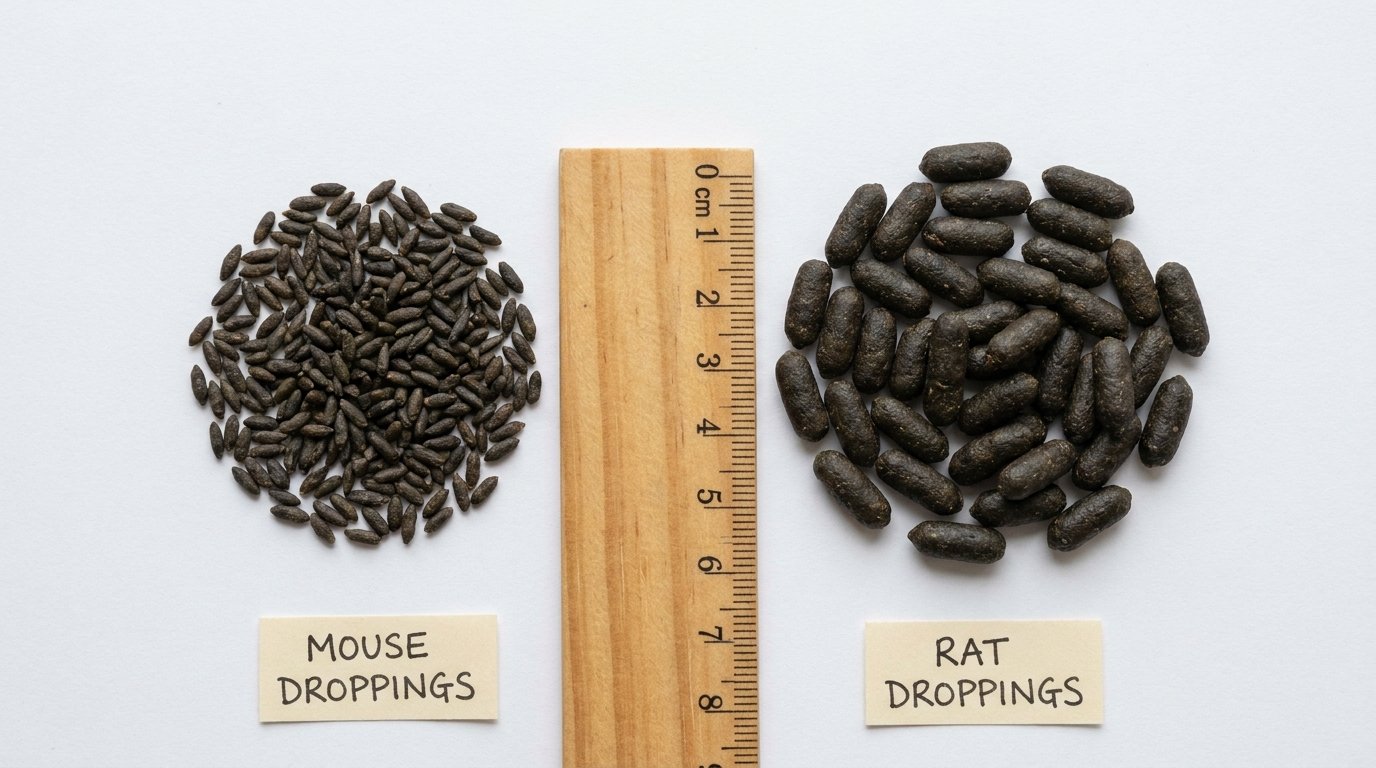
Norway rats vs roof rats. Norway rats — the most common rat in Toronto and the GTA — leave large droppings with blunt, rounded ends. Roof rats leave slightly smaller droppings with pointed ends. If you find droppings that are clearly bigger than a grain of rice, it's worth getting a professional identification rather than guessing.
Other signs that point to rats rather than mice:
- Burrows along your foundation or under decks and sheds
- Larger gnaw holes (roughly the size of a loonie or bigger)
- Heavier thumping sounds rather than light scratching
- Greasy rub marks along walls at a higher level
For a full comparison of the animals themselves, read mouse vs rat: how to tell the difference.
Other Droppings That Look Like Mouse Poop
Not every small dark pellet is from a mouse. These are the droppings most often confused with mouse poop:
| Source | What they look like | How they differ from mouse poop |
| Bats | Similar size, dark, found in piles | Piled up under one roosting spot (often in the attic or against an exterior wall); may sparkle because of insect wing fragments; crumble into powder |
| Cockroaches | Tiny specks like black pepper or coffee grounds; larger roaches leave small ridged cylinders | Much smaller, often with brown smear marks, found in cabinets, near appliances and in corners |
| Squirrels | Larger (about 8–10 mm), rounder, sometimes lighter brown | Bigger and more rounded; usually found in the attic, often in clusters |
| Rats | 12–20 mm | Much bigger — see the comparison table above |
Bat droppings in particular should not be handled or disturbed by hand. If you think you have bats in the attic, bats are protected wildlife in Ontario, so contact a wildlife professional rather than trying to remove them yourself.
Why Is Mouse Poop Green or an Unusual Colour?
Mouse droppings are usually dark brown or black, but colour can change with diet:
- Green or blue droppings can be a sign that mice have been eating rodent bait, because many baits are dyed a bright colour. If you haven't put out bait, a neighbour or previous owner may have.
- Lighter brown droppings can appear when mice are eating grains, cereal or pet food.
- Grey droppings are usually just old and dried out.
Colour on its own won't tell you much about the size of the problem — the location and freshness of the droppings matter more.
What About Mouse Urine?
Where there are droppings, there's usually urine too. It's hard to see, but you may notice a sharp, musty, ammonia-like smell in cupboards or enclosed spaces, or yellowish stains on stored items. In long-term infestations, mice can leave small mounds of dirt, grease and urine known as urine pillars. Read more in what mouse urine looks and smells like.
Is Mouse Poop Dangerous?
Mouse droppings, urine and nesting material can carry germs, so they should never be handled with bare hands. In Canada, the main concern is hantavirus, which is linked to deer mice. It spreads mainly when dried droppings, urine or nesting material are disturbed and tiny particles get into the air — which is why sweeping or vacuuming droppings is not recommended. Rodent droppings can also carry bacteria such as Salmonella that can contaminate food and surfaces.
The risk from occasional house mouse droppings in a home is low when you clean up correctly, but it isn't zero. For more, read do mice carry diseases?.
Health note: If you develop fever, muscle aches or breathing problems after cleaning up after rodents, contact a healthcare provider and tell them about the rodent exposure.
Found Mouse Droppings? What to Do Next
- Don't sweep or vacuum them. This can send particles into the air.
- Air out the area by opening windows and doors for at least 30 minutes before cleaning.
- Wear gloves (and a well-fitting mask for large amounts or enclosed spaces like attics).
- Wet the droppings with a household disinfectant or diluted bleach solution, following the product label, and let it soak for several minutes.
- Wipe up with paper towels, seal everything in a plastic bag and put it in the garbage. Then disinfect the area and wash your hands thoroughly.
- Throw out any food that mice have chewed into or that has droppings in or on it.
- Check again in one to two days to see if new droppings appear.
- Find out how the mice are getting in, and deal with the mice that are already inside.
Full step-by-step instructions are in how to clean up mouse droppings safely. For the complete removal plan from sealing entry points to humane trapping read our complete guide to getting rid of mice humanely.
When to Call a Professional
Cleaning up droppings deals with the evidence, not the mice. It's time to call a pest professional if:
- New droppings keep appearing after you clean
- You find droppings in several rooms or on more than one floor
- Droppings are in the attic, inside walls or in insulation
- The droppings look larger than a grain of rice (possible rats)
- You've found a nest or there's a strong urine smell
- You have young children, pets or health concerns in the home
How Nomore Pest Can Help
Nomore Pest is a licensed and insured pest control company serving Toronto, Mississauga, Vaughan, Scarborough, North York and Etobicoke. During an inspection, our technicians confirm whether the droppings are from mice or rats, track them back to where the rodents are nesting and getting in, and recommend a treatment and exclusion plan that fits your home. Learn more about our mouse control services in Toronto.
Found droppings? Book a mouse inspection or call 800-461-1827 / 437-922-2705. You can also email info@nomorepest.ca.
Conclusion
Mouse poop is small (3–6 mm), dark and rice-shaped, with pointed ends, and it's usually scattered along the routes mice travel. Fresh, shiny droppings mean mice are active now; anything much larger than a grain of rice could point to rats. Clean up safely, check for new droppings, and deal with how the mice are getting in. If the droppings keep coming back, Nomore Pest rodent team can find the source and stop it.
Frequently asked questions
What does mouse poop look like?
Mouse poop looks like small, dark grains of rice about 3–6 mm long, with pointed ends. Fresh droppings are black and shiny; old droppings are grey, dull and dry. They are usually scattered along walls, in drawers and cupboards, and behind appliances.
How can I tell rat poop from mouse poop?
Size is the easiest clue. Mouse droppings are about 3–6 mm long with pointed ends. Rat droppings are much bigger — about 12–20 mm — and thicker, often with blunt ends. Rats also leave fewer, larger droppings in groups, while mice leave many small ones scattered around.
How do I know if mouse droppings are fresh?
Fresh droppings are black, shiny, moist and soft. Old droppings are grey, dry and hard. To be sure, clean up an area safely and check it again after one to two days — new droppings mean the mice are still active.
What else looks like mouse poop?
Bat droppings, cockroach droppings and squirrel droppings are often mistaken for mouse poop. Bat droppings pile up under a roost and crumble easily, cockroach droppings are much smaller and look like black pepper, and squirrel droppings are larger and rounder.
Is it dangerous to touch mouse droppings?
Don't touch them with bare hands. Droppings and urine can carry germs, and in Canada, deer mice can carry hantavirus. Wear gloves, wet droppings with disinfectant before wiping them up, and never sweep or vacuum them.
Does finding mouse droppings mean I have an infestation?
Not always, but it does mean mice have been inside. If you keep finding fresh droppings after cleaning, or find them in more than one area, you likely have an active infestation that needs to be dealt with.
How many mice do I have if I find droppings?
Droppings can't give you an exact count, because one mouse can leave dozens of droppings a day. Droppings spread across several rooms or floors are a better sign of a larger population than a heavy amount in one spot.
Got a pest problem? Don't wait.
Book a professional inspection across Toronto & the GTA and get peace of mind, backed by a licensed & insured local team.
Or email us at info@nomorepest.ca · Toronto & the GTA