You saw something dart along the baseboard, or found droppings behind the stove. Was it a mouse or a rat?
It matters more than you'd think. Mice and rats behave differently, get in through different gaps, and need different traps, baits and sealing work. Treating a rat problem like a mouse problem is one of the most common reasons DIY control fails.
Here's how to tell them apart, from size and tail to droppings and gnaw marks.
Quick Fact About Mouse vs rat
| Feature | House mouse | Norway rat |
| Body length | 7–10 cm | 20–25 cm |
| Weight | About 15–30 g | About 300–500 g |
| Tail | Thin, about as long as the body, lightly furred | Thick, scaly, shorter than the body |
| Ears | Large for the head | Small relative to the head |
| Snout | Pointed, triangular | Blunt, heavy |
| Droppings | 3–6 mm, pointed ends | 12–20 mm, blunt ends |
| Gnaw holes | About the size of a dime | About the size of a loonie or larger |
| Behaviour | Curious, investigates new objects | Cautious, avoids new objects for days |
What is the Difference Between Mouse vs Mice vs Rat
One thing to clear up first: mouse is one animal, mice is more than one. They're the same animal. A rat is a different, larger rodent. So "mice vs rat" and "mouse vs rat" both mean the same comparison.
Size: The Biggest Clue
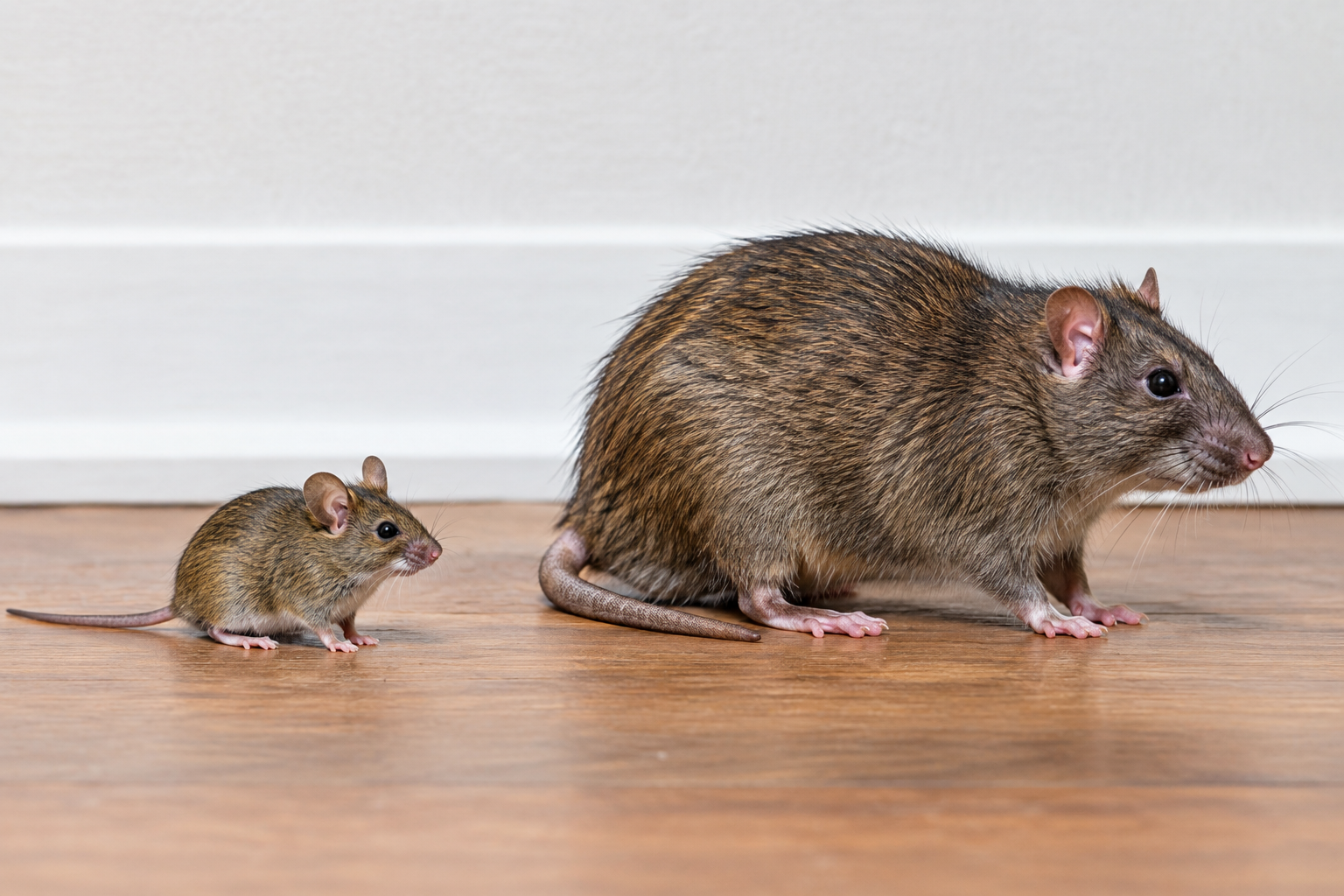
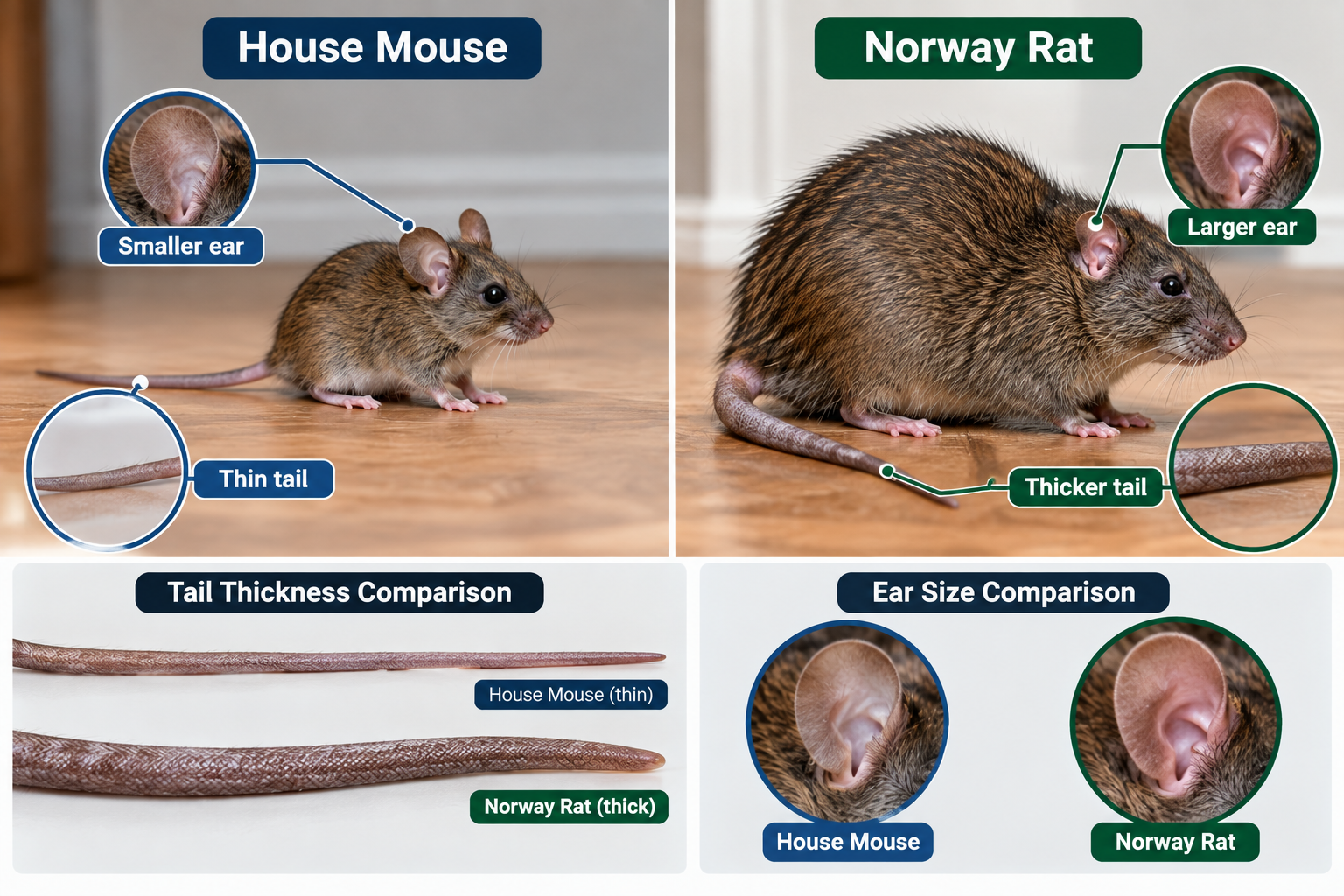
An adult house mouse has a body about 7–10 cm long — roughly the size of your thumb, not counting the tail — and weighs less than a slice of bread. An adult Norway rat, the common rat in Toronto and the GTA, has a body 20–25 cm long and can weigh more than ten times as much.
If the animal looked heavy-bodied and moved with a noticeable weight to it, it was almost certainly a rat. Mice look light and move in quick, darting bursts.
Was it a young rat or an adult mouse?
This is the confusion that catches most people out, because a young rat and an adult mouse can be a similar size. Look at the proportions rather than the overall size:
| What to look at | Adult mouse | Young rat |
| Head | Small, in proportion to the body | Large and heavy for its body |
| Feet | Small and delicate | Noticeably large for its body |
| Tail | Thin and fine, about as long as the body | Thick and scaly, looks heavy |
| Ears | Large, thin, standing out from the head | Smaller in proportion, thicker |
A good rule: if the head, feet and tail look too big for the body, it's a young rat.
Tail, Ears and Face
- Tail. A mouse tail is thin, hairy and about as long as its body. A rat tail is thick, mostly hairless and scaly, and usually shorter than its body.
- Ears. Mice have large ears for their head size. Rats have smaller, thicker ears relative to their head.
- Face. Mice have a pointed, triangular snout. Rats have a blunt, heavy snout.
- Eyes. Mouse eyes look large and prominent. Rat eyes look small in a bigger head.
- Fur. House mice are usually light brown to grey with a paler belly. Norway rats are brown to grey-brown with a coarse coat and a lighter underside.
Mouse vs Rat Droppings
Droppings are often the first — and sometimes the only — evidence you find.
| Feature | Mouse droppings | Rat droppings |
| Length | 3–6 mm (grain of rice) | 12–20 mm (olive pit) |
| Shape | Thin, pointed ends | Thicker, blunt or spindle-shaped ends |
| Amount | Many, scattered widely along walls | Fewer, larger, often grouped together |
| Where | Drawers, cupboards, under sinks, behind appliances | Basements, along foundations, garages, near burrows |
For photos, fresh vs old droppings and how to clean them up safely, see what mouse poop looks like.
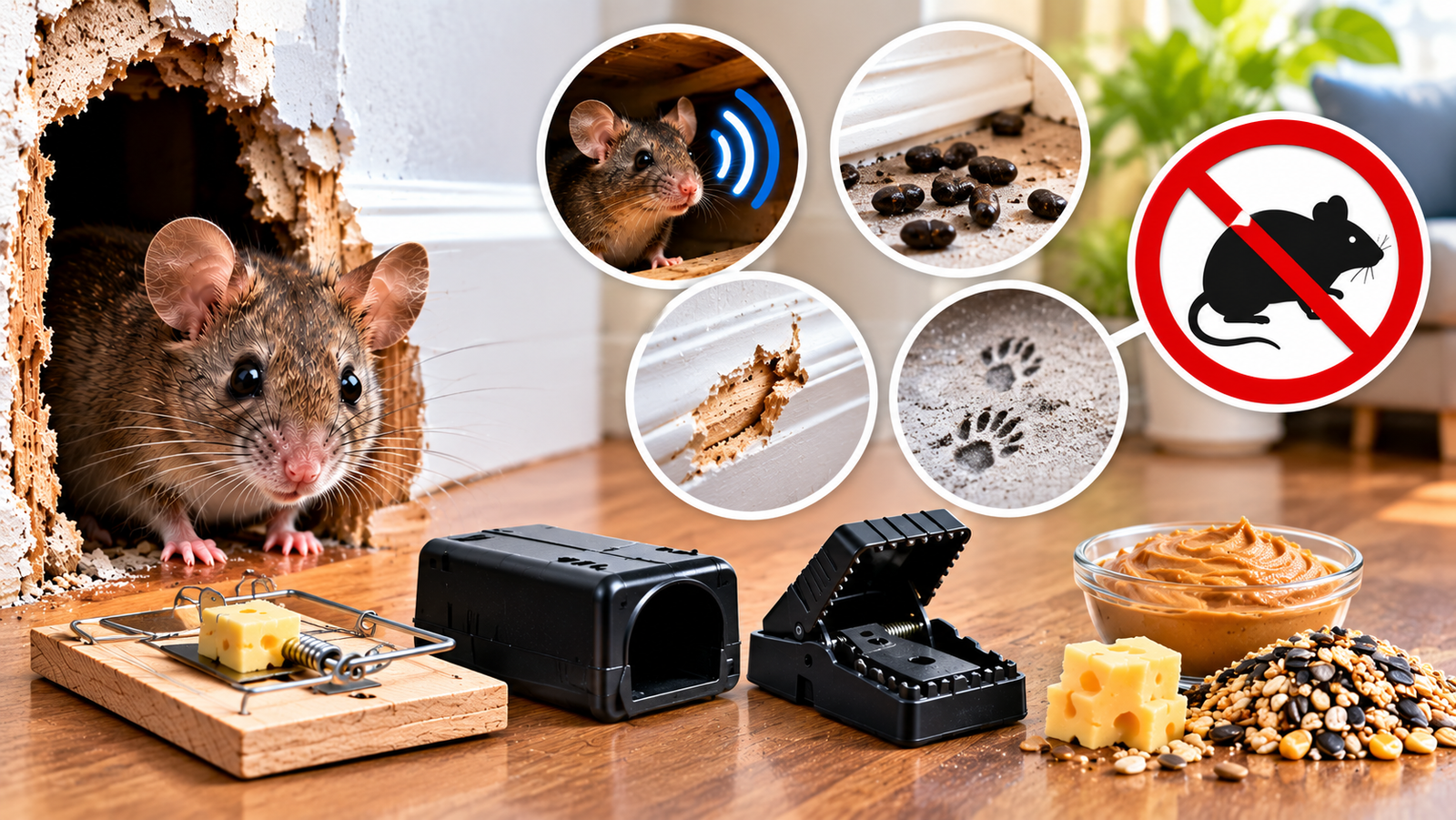
Other Signs That Tell Them Apart
| Sign | Points to mice | Points to rats |
| Gnaw holes | Small, about the size of a dime, with clean edges | Larger, about the size of a loonie or bigger, with rough edges |
| Sounds | Light, fast scratching and faint squeaks | Heavier scratching, thumping and gnawing |
| Grease marks | Faint smudges low along walls | Dark, heavy rub marks, often higher up |
| Burrows | Rare — mice nest indoors or in sheltered spots | Common — Norway rats dig burrows along foundations, under decks and sheds |
| Tracks | Small footprints and a light tail drag in dust | Larger footprints and a clear tail drag |
| Nests | Shredded paper, fabric and insulation in hidden spots | Larger nests, often in burrows, basements or under debris |
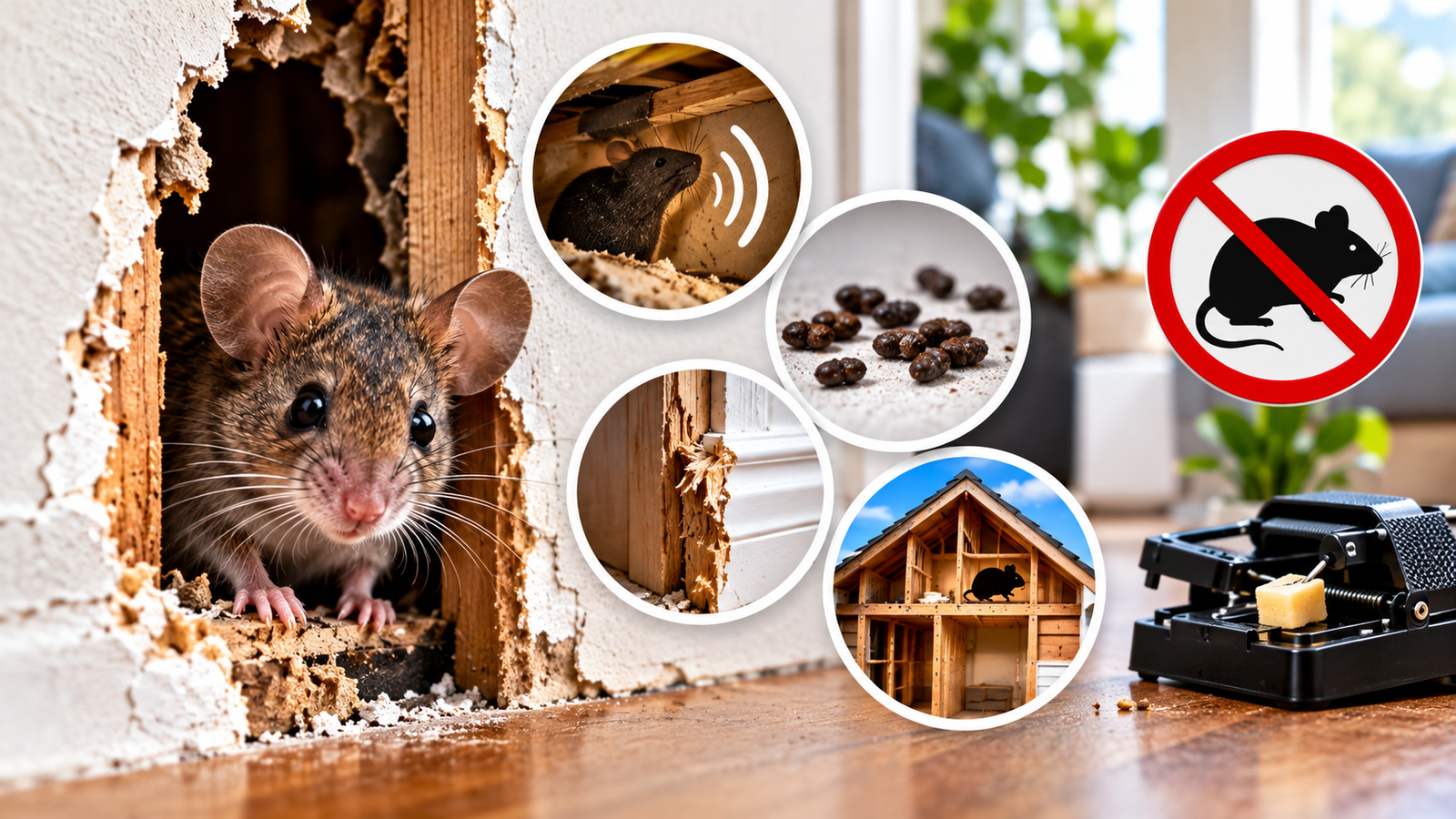
If you're hearing the sounds but haven't seen anything, our guide to mice in walls explains how to work out what's moving around in there.
Behaviour: Why It Changes How You Treat Them
This is where the difference really matters.
- Mice are curious. They investigate new objects quickly, which is why a well-placed trap often catches a mouse within a night or two.
- Rats are cautious. They avoid anything new in their environment for days. Traps set for rats often need to be left unset and baited first so the rats get used to them.
- Range. A mouse usually stays within a few metres of its nest, so traps must be very close to where you see droppings. Rats range much further, so treatment covers a wider area.
- Food and water. Mice get much of the moisture they need from food and can live without drinking. Rats need to drink regularly, so they stay near a water source.
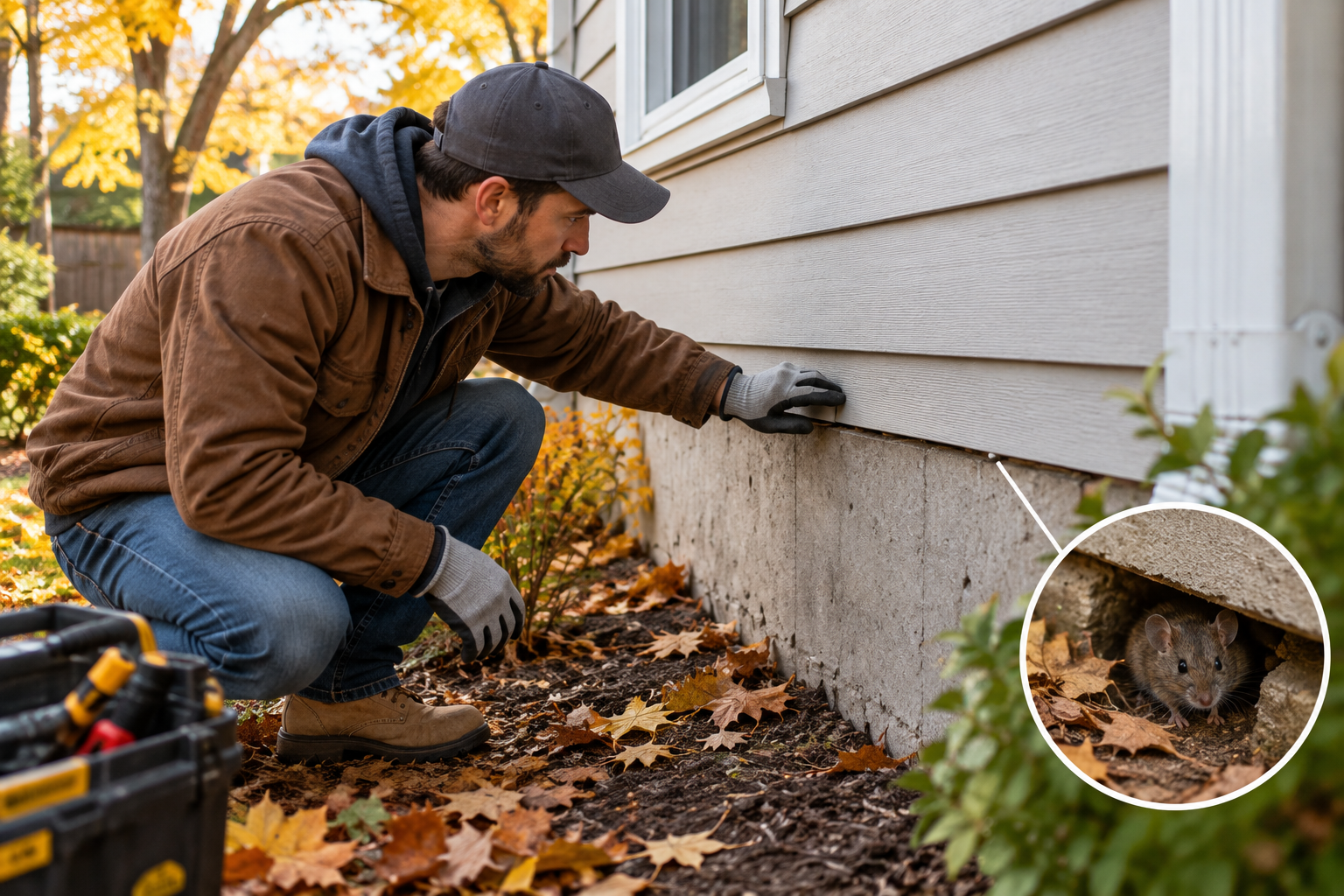
- Entry gaps. A mouse can get through a gap about 6 mm wide. A rat needs roughly twice that — but rats also gnaw small holes into bigger ones. See how mice get into your house.
For trap choice and placement, see see the best mouse traps and bait and note that rat traps are a different size and strength.
Which Ones Live in the GTA?
- House mouse — the most common rodent found inside Toronto-area homes, all year round.
- Deer mouse — common in garages, sheds, cottages and rural properties. Similar in size to a house mouse, with a white belly and a two-tone tail. Deer mice are linked to hantavirus in Canada, so take extra care with droppings.
- Norway rat — the common rat in the GTA. Heavy-bodied, brown, burrows along foundations, in sewers and under decks.
- Roof rat — slimmer, with a longer tail and a better climber. Much less common in this region than the Norway rat.
For more on the mouse species you might find in Ontario.
Animals often mistaken for mice and rats
| Animal | How to tell |
| Vole | Stocky body, short tail, small ears and eyes; lives outdoors in lawns and gardens, and rarely comes indoors |
| Shrew | Very small with a long pointed snout; not a rodent |
| Chipmunk | Striped back, active during the day, lives outdoors |
| Young squirrel | Bushy tail and much larger feet |
A vole is the one most often confused with a mouse. If you're seeing small runways in the lawn and damage to plants but nothing inside the house, voles are more likely than mice.
Can Mice and Rats Live in the Same House?
Usually not in the same space. Rats are bigger and will kill or drive off mice, and mice tend to avoid areas where rats are active. Given the choice, mice move out or stay in parts of the building rats don't use.
That said, in large buildings with plenty of food — restaurants, warehouses, older apartment buildings — both can be present in different areas at the same time.
Do rats eat mice? Yes. Rats are opportunistic and will kill and eat mice. So if you had mice and the signs suddenly changed — bigger droppings, heavier sounds, larger gnaw holes — it's worth checking whether rats have moved in.
Why Getting the ID Right Matters
| If it's a mouse | If it's a rat |
| Seal gaps larger than about 6 mm | Seal gaps larger than about 12 mm, and use heavier materials |
| Mouse-size snap or live traps | Larger, stronger rat traps |
| Traps within a couple of metres of droppings | Traps across a wider area, often along walls and near burrows |
| Traps usually work within a night or two | Rats may need several days to accept traps |
| Focus on kitchens, walls and cupboards | Also check the foundation, basement, garage and yard for burrows |
Using mouse traps for a rat problem is a common mistake — a rat can take the bait, set off a mouse trap and escape, which makes it warier and harder to catch afterwards.
When to Call a Professional
Call a pest control company if:
- You're not sure whether you have mice or rats
- You've found droppings larger than a grain of rice
- There are burrows along your foundation, deck or shed
- You hear heavy sounds in walls, ceilings or the attic
- Traps aren't working, or the problem keeps coming back
Nomore Pest Can Identify It for You
Nomore Pest is a licensed and insured pest control company serving Toronto, Mississauga, Vaughan, Scarborough, North York and Etobicoke. During an inspection we confirm which rodent you're dealing with, find where they're nesting and getting in, and use the right traps, materials and gap sizes for that species. Learn more about our rodent control services in Toronto.
Not sure what's in your home? Book an inspection or call 800-461-1827 / 437-922-2705. You can also email info@nomorepest.ca.
Conclusion
Size is the quickest test: a house mouse is thumb-sized with big ears, a pointed face and a thin tail, while a Norway rat is heavy-bodied with small ears, a blunt face and a thick, scaly tail. If the head, feet and tail look oversized, it's a young rat. Droppings confirm it a grain of rice means mice, an olive pit means rats. Once you know which one you have, you can choose the right traps and seal the right size of gaps. For the full removal plan, see our complete guide to getting rid of mice humanely, or let Nomore Pest identify it for you.
Frequently asked questions
What is the difference between a mouse and a rat?
A house mouse has a body 7–10 cm long, large ears, a pointed snout and a thin tail about as long as its body. A Norway rat is much bigger 20–25 cm with smaller ears, a blunt snout and a thick, scaly tail. Rat droppings are also about three times the size of mouse droppings.
How do I tell a young rat from an adult mouse?
Look at the proportions. A young rat has a head, feet and tail that look too large for its body, and its tail is thick and scaly. An adult mouse is in proportion, with a fine, thin tail and large, thin ears.
Are rat droppings bigger than mouse droppings?
Yes. Mouse droppings are about 3–6 mm long with pointed ends, roughly the size of a grain of rice. Rat droppings are about 12–20 mm long and thicker, usually with blunt ends.
Do rats eat mice?
Yes. Rats will kill and eat mice, which is one reason the two don't usually share the same space. If your mouse signs changed suddenly to larger droppings and heavier sounds, rats may have moved in.
Can mice and rats live in the same house?
Not usually in the same area. Mice avoid places where rats are active. In large buildings with plenty of food, both can be present in different parts of the building.
Is a vole a mouse?
No. A vole is a different rodent with a stockier body, a short tail and small ears and eyes. Voles live outdoors in lawns and gardens and rarely come into homes.
Does it matter whether I have mice or rats?
Yes. They need different trap sizes, different bait strategies and different gap sizes when sealing your home. Using mouse-sized traps and materials on a rat problem usually fails.
Got a pest problem? Don't wait.
Book a professional inspection across Toronto & the GTA and get peace of mind, backed by a licensed & insured local team.
Or email us at info@nomorepest.ca · Toronto & the GTA