
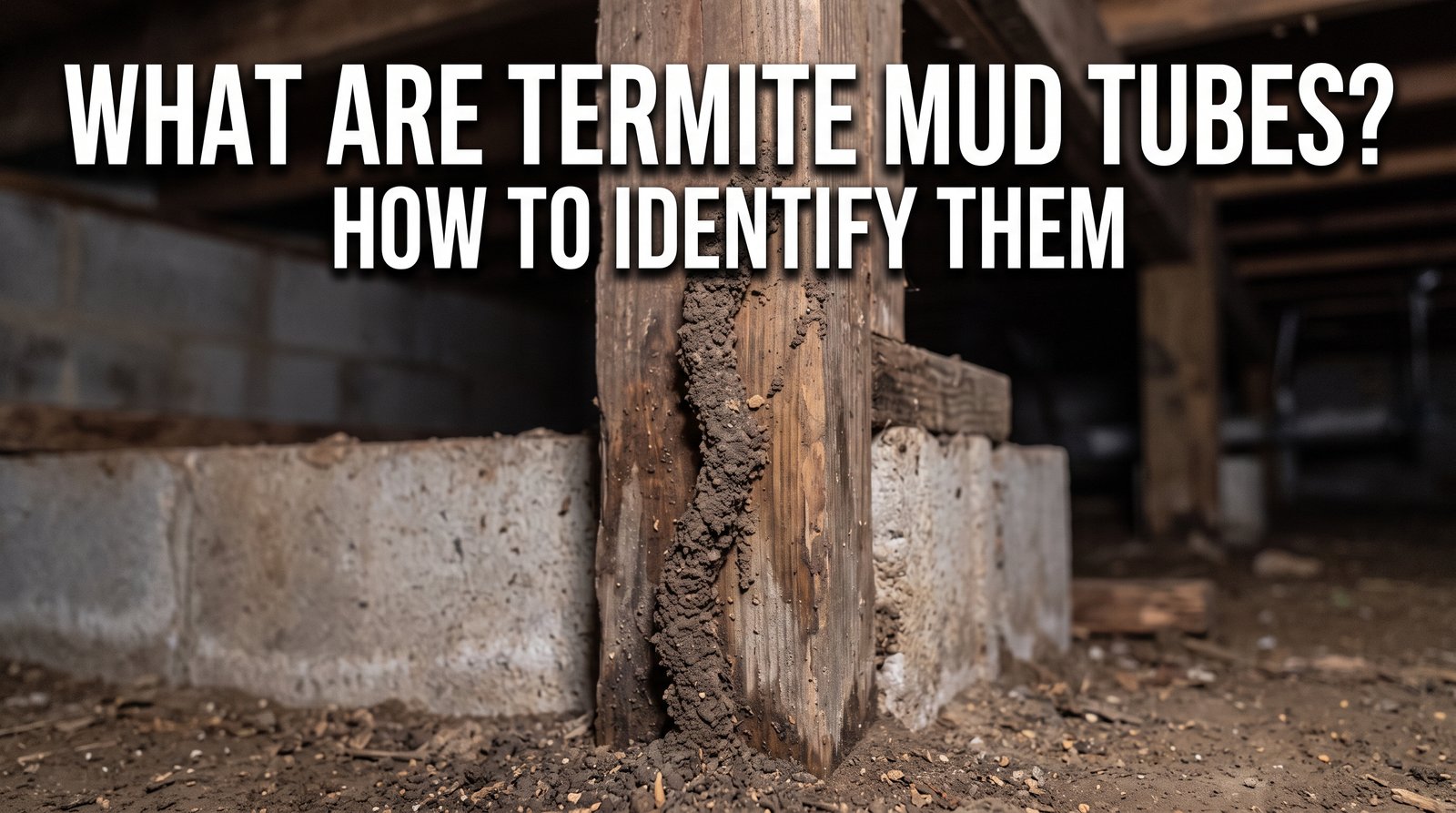
You are walking past the side of your house and notice a thin line of dried mud running up the foundation. It is about as wide as a pencil, almost the same colour as the soil, and you are fairly sure it was not there last summer.
That line is almost certainly a termite mud tube.
Mud tubes are protective tunnels built by subterranean termites so they can travel between their nest in the soil and the wood inside your home. They are one of the clearest signs of termite activity you can find.
Unlike the other signs of a termite infestation, they are often visible from outside without opening a single wall.
This guide covers what termite mud tubes look like, the four types you might come across, where to check on your own property, and how to work out whether the tube in front of you is still in use.
What Do Termite Mud Tubes Look Like?
Most termite mud tubes are roughly the width of a pencil — somewhere between 6 and 25 mm, or a quarter-inch to an inch across. Some are thin and wavy, like a pencil line drawn freehand. Others are flatter and broader, closer to a drinking straw pressed against the wall.
The colour is what makes them so easy to walk past. They are tan, brown or grey, which is almost exactly the colour of soil, concrete block and poured foundation. On a dusty basement wall, a mud tube can sit in plain sight for years.
Run a finger across one and it feels gritty and slightly rough, and it crumbles under light pressure. That texture comes from what the tube is made of: soil, small wood particles, termite saliva and fecal matter, packed together and left to harden.
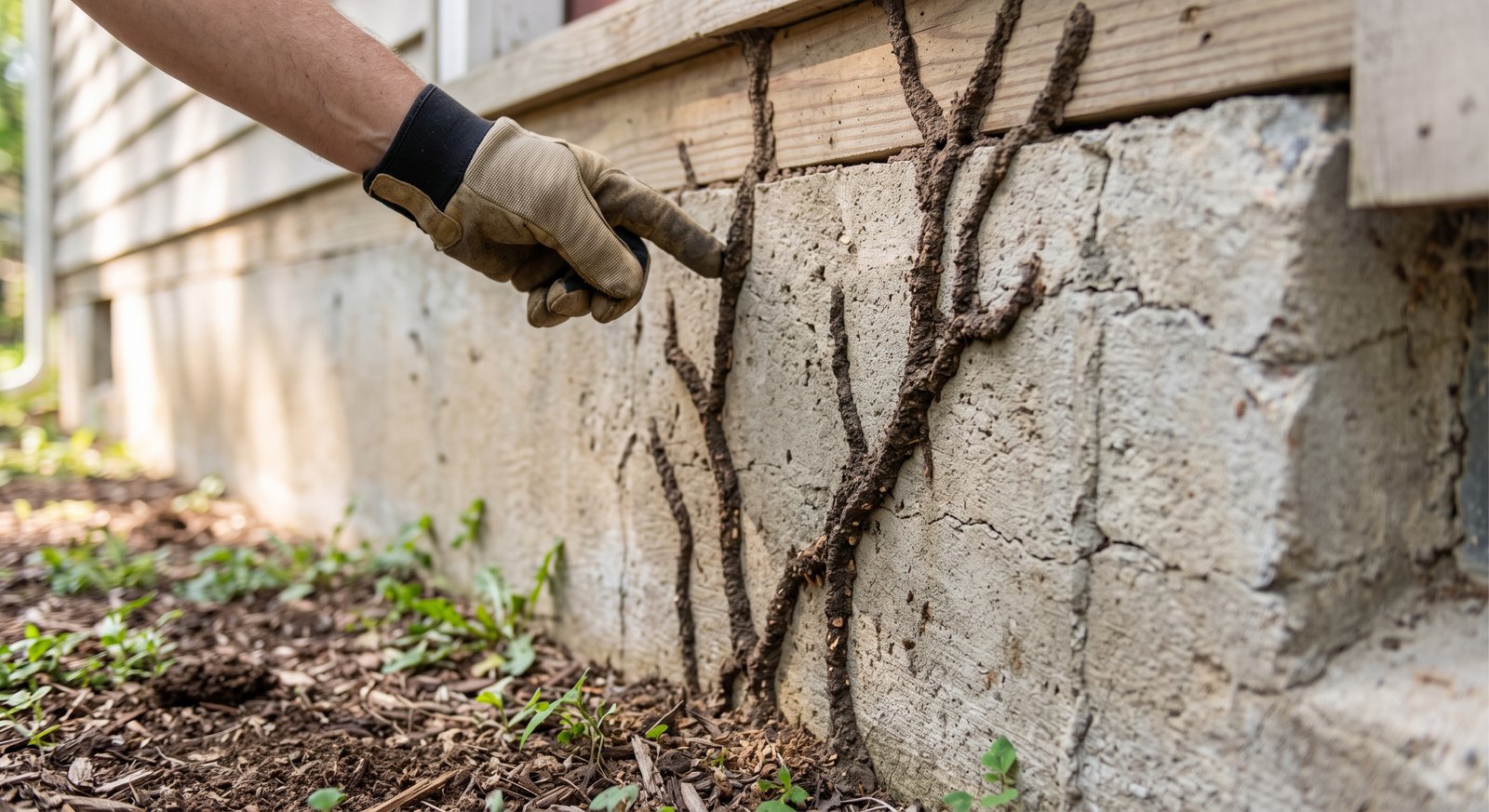
Entomologists call them shelter tubes or mud leads. The purpose is straightforward — subterranean termites dry out quickly in open air, so they build an enclosed, humid corridor rather than crossing exposed surfaces.
Direction is worth noting too. Most tubes climb vertically from soil to wood, but they also run sideways across foundations, along pipes, over beams and around obstacles.
Age leaves clues. A fresh tube looks darker and slightly damp. An older one is pale, dry and brittle, and may flake away when touched.
One common look-alike
Not every mud structure on a wall is a termite tube. Mud daubers — solitary wasps — build smooth, tidy clay tubes on sheltered walls, ceilings and under eaves, and they are frequently mistaken for termite work.
The difference is easy once you know it. Mud dauber nests are smooth, organised and never connect to the ground. Termite tubes are gritty, irregular, and always lead back to soil.
The 4 Types of Termite Mud Tubes
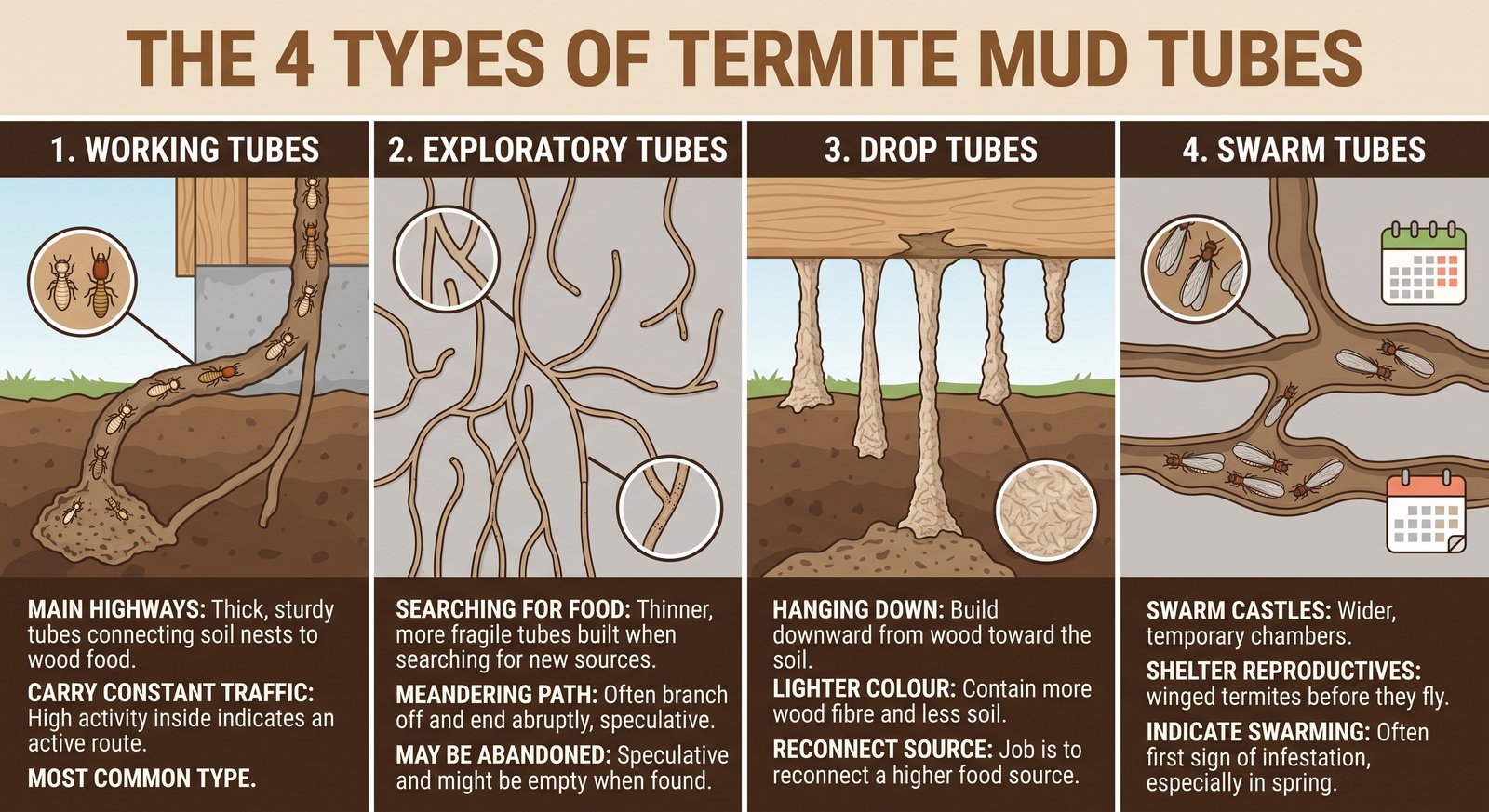
Termites do not build one kind of tube for every job. There are four, and knowing which one you are looking at tells you something useful about what is happening on your property.
1.Working tubes
These are the main highways, running between the nest in the soil and the wood the colony is feeding on. They are the most common type and the sturdiest of the four.
Working tubes carry constant traffic, so finding one means you have almost certainly found an active route rather than an abandoned one.
2.Exploratory tubes
Thinner and noticeably more fragile, exploratory tubes are built while the colony searches for new food. They often wander, branch off, and end abruptly in mid-air.
These can extend a surprising distance — several metres up a wall in some cases. Because they are speculative, an exploratory tube may already have been abandoned by the time you spot it.
3.Drop tubes
Drop tubes hang downward from wood toward the soil, rather than climbing up from it. They look a little like small stalagmites in a cave.
They tend to be lighter in colour than the other types because they contain more wood fibre and less soil. Their job is to reconnect a food source above with the colony below.
4.Swarm tubes
Also called swarm castles, these are temporary chambers built to shelter winged reproductive termites before they fly. They can be noticeably wider than the other types.
In Ontario, swarming happens in spring, which is when most homeowners first realise something is wrong. If you have seen winged insects indoors, it is worth reading how to tell spring termite swarmers apart from flying ants before you assume the worst.
Where Termite Mud Tubes Are Found
Termites need two things: moisture, and a route from soil to wood. Every place a mud tube shows up is a place where those two conditions meet.
Outside the house, check the foundation walls first, then porch supports, deck posts, garage walls and exterior steps. Pay particular attention near downspouts and hose bibs, where the soil stays damp longest.
Inside, the highest-risk areas are basement walls, crawl spaces, sill plates, floor joists and the underside of the subfloor. Tubes also appear behind baseboards and around plumbing penetrations where pipes pass through the floor.
The places people miss are almost always the places nobody looks. Behind stored boxes, under the stairs, behind the furnace or water heater, and in the corners of a crawl space that never get a flashlight pointed at them.
A basic check needs very little equipment. Take a bright flashlight and a screwdriver, work slowly along the base of every exterior wall, and tap any wood that looks suspect.
How to Tell If Mud Tubes Are Active
Finding a tube tells you termites have been there. It does not tell you whether they still are — and there is a simple test for that.
Break away a short section of the tube, about two inches, and note the date. Come back in three to five days and look at the gap.
If the tube has been rebuilt, the colony is active and using that route right now. Termites depend on these corridors, so they repair damage quickly.
If it has not been rebuilt, be careful how you read that. It is not proof that your property is clear — the colony may simply have switched to a different route, or be feeding somewhere else on the same structure.
You may also find termites inside the tube when you break it. Workers are small, pale, soft-bodied and roughly the size of a grain of rice, which is quite different from the darker, harder-bodied ants people often expect to see.
One thing to be clear about: breaking a tube is a diagnostic step, not a treatment. It removes evidence an inspector would want to see and has no effect whatsoever on the colony underground.
If what you are finding looks more like hollowed galleries and coarse sawdust than mud tubes, it may not be termites at all — how termite damage differs from carpenter ant damage is worth a read before you go further.
Mud Tubes in Toronto Basements and Crawl Spaces
Ontario has one termite species that matters: the eastern subterranean termite, Reticulitermes flavipes. It lives in the soil, needs constant moisture, and cannot survive long in open air which is precisely why it builds mud tubes in the first place.
Termite activity has been documented across several older Toronto neighbourhoods, including Cabbagetown, the Annex, the Beaches, parts of East York and areas of Scarborough. These are not the only places termites turn up, but they are where the conditions line up.
Older GTA housing is more vulnerable for practical reasons. Pre-1960 construction, rubble and stone foundations, unfinished basements, and wood-to-soil contact at porches and decks all give termites an easy route in.
There is one belief worth correcting directly. A Toronto winter does not end an infestation.
Subterranean termite colonies survive below the frost line, where soil temperature stays stable. Inside a heated basement, workers can stay active through January the same as they would in July.
Finished basements complicate things further. Drywall, framing and insulation hide the exact surfaces where tubes would otherwise be obvious, which is a large part of why activity in GTA homes is so often discovered late.
What to Do If You Find Termite Mud Tubes
Do not scrape the tubes away. It feels like progress, but it destroys the evidence an inspector needs to trace the route and judge how far the activity extends.
Do not reach for a retail spray. Surface products treat the surface. The colony driving the problem lives in the soil, sometimes several metres from the tube you can see, and nothing you apply to a wall will reach it.
What actually helps is documentation. Photograph the tube, note exactly where it is, write down the date, and then leave it alone.
This is where subterranean termites differ from most household pests. With ants or wasps, treating what you can see usually works. With termites, the visible tube is the end of a system that runs underground and out of reach.
A professional inspection is about locating that system. A technician traces the tubes, checks the structural wood, looks for moisture and soil contact around the foundation, and establishes how far activity has spread before recommending treatment.
If you have found mud tubes on your property, booking a professional termite inspection is the sensible next step.
Conclusion:
A mud tube is not a cosmetic problem or a bit of dried dirt on a wall. It is a working structure, built for a reason, and it means termites have found a route into your home.
The good news is that mud tubes are visible, and they show up long before most homeowners notice damage. Catching one early is often the difference between a straightforward treatment and a structural repair bill.
Nomore Pest inspects and treats termite activity across Toronto and the GTA. If you have found something on your foundation, in your basement or in a crawl space and you are not sure what you are looking at, send us a photo and we will tell you what it is.
Frequently asked questions
Are mud tubes always a sign of termites?
Mud tubes are built by subterranean termites, so finding a genuine one means termites have been active. Some things are mistaken for them, though — mud dauber wasp nests, dried splash marks from rain, and white efflorescence on concrete. Termite tubes are gritty and always connect back to soil.
What happens if you break a termite mud tube?
Nothing happens to the colony — the nest is underground and unaffected. Breaking a short section is useful as a test: if the tube is rebuilt within a few days, the route is active. It is a diagnostic step, not a treatment, and it removes evidence an inspector would want to see.
I found mud tubes but no termites. What does that mean?
It does not mean the property is clear. The tube may be an exploratory one that was abandoned, or the colony may have switched to a different route into the same structure. Termites are rarely visible on the surface, so absence of insects is not evidence of absence of infestation.
How fast do termites rebuild mud tubes?
Repairs can begin within a day or two, because the colony depends on these corridors to move safely between soil and wood. That speed is exactly what makes the break test reliable — check the gap after three to five days and you will have a clear answer.
Should I remove termite mud tubes myself?
No. Removing them is cosmetic, achieves nothing against the colony, and destroys the trail a technician uses to work out how far activity has spread. Photograph the tube, note the location and date, and leave it in place for the inspection.
How wide are termite mud tubes?
Most are roughly the width of a pencil — between 6 and 25 mm, or a quarter-inch to an inch across. Some are thin and wavy, others flatter and broader. They are usually tan, brown or grey, which is why they blend into soil and concrete so easily.
Do termites build mud tubes in winter in Ontario?
Yes. Eastern subterranean termite colonies survive below the frost line where soil temperature stays stable, and inside a heated basement workers can stay active all year. A Toronto winter slows activity outdoors but does not end an infestation inside a home.
How do I tell a termite mud tube from a mud dauber nest?
Mud dauber nests are smooth, tidy clay tubes built on sheltered walls, ceilings and under eaves, and they never connect to the ground. Termite mud tubes are gritty and irregular, and always run back to soil. Mud daubers are solitary wasps and are not a structural threat.
Got a pest problem? Don't wait.
Book a professional inspection across Toronto & the GTA and get peace of mind, backed by a licensed & insured local team.
Or email us at info@nomorepest.ca · Toronto & the GTA