You've spotted winged insects on a windowsill, a pile of what looks like sawdust under a baseboard, or a soft, hollow-sounding spot in a door frame — and now you're trying to figure out whether you're dealing with termites or carpenter ants.
It's one of the most common questions Ontario homeowners ask us, and for good reason: both pests target wood, both can cause real structural damage, and both are frequently misidentified until the problem has already grown.
The good news is that termites vs carpenter ants is actually an easy call once you know what to look for. They differ in body shape, wings, colour, diet, and behaviour — and the signs they leave behind in a Toronto-area home are different too.
In this guide, we'll break down exactly how to identify each pest, when they're most active in the GTA, and what actually works to get rid of them.
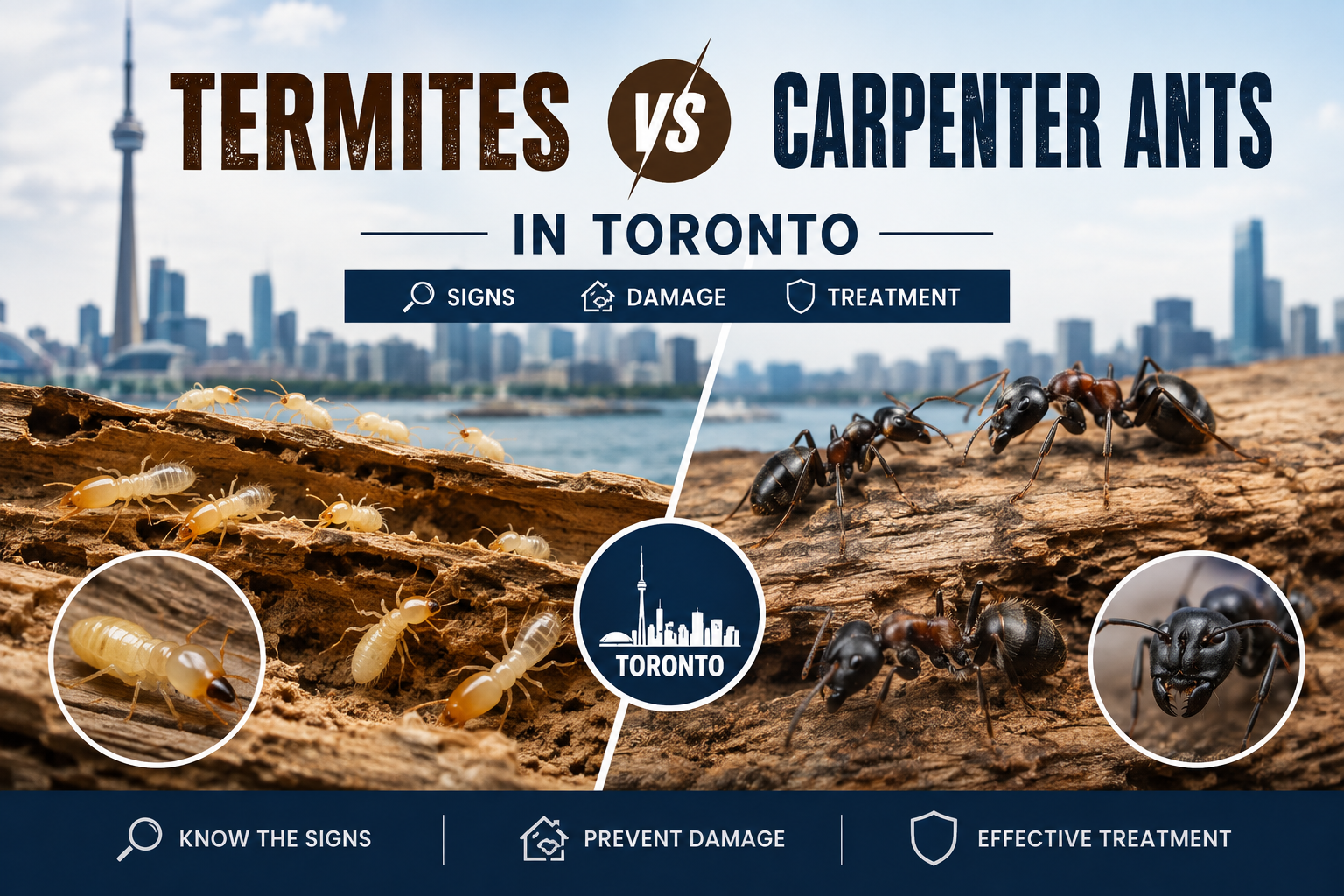
Termites vs Carpenter Ants at a Glance
| Feature | Termites | Carpenter Ants |
| Waist | Thick, straight-sided (no pinch) | Narrow, pinched waist |
| Antennae | Straight, bead-like segments | Bent or "elbowed" |
| Wings (swarmers) | Two pairs, equal length | Two pairs, front wings longer than back |
| Colour | Cream, pale brown to dark brown | Black, or black with reddish tones |
| Diet | Eat wood for cellulose | Do not eat wood — excavate it to nest |
| Damage pattern | Mud tubes, layered galleries, damp wood debris | Smooth, sanded-looking tunnels, coarse wood shavings |
| Speed of damage | Slower to start, more severe over years | Slower and more localized, but progressive |
| Peak activity in Ontario | Swarms late spring through summer | Most active May through July |
Keep this table in mind as a quick reference — but the sections below go deeper into each difference, because getting the identification right changes how the problem should be treated.
How Big Are Termites Compared to Carpenter Ants?
Size alone isn't a reliable way to tell these two apart, since both insects vary depending on their role in the colony. Worker termites are typically 6 to 9 mm long, while carpenter ant workers in Ontario range more widely from about 6 mm up to 13 mm for major workers, making carpenter ants the largest common ant species found in the GTA.
Where size becomes useful is with swarmers (the winged reproductive members of each colony): termite swarmers look uniform in length because their two pairs of wings are the same size, while carpenter ant swarmers look slightly lopsided in flight, since their front wings are noticeably longer than their back pair.
If you're trying to judge by size alone in a jar or on a windowsill, look at the wings first — it's a far more dependable clue than body length.
What Are the Physical Differences Between Termites and Carpenter Ants?
This is where identification gets reliable. Four features separate termites from carpenter ants every time:
Body shape. Termites have a thick, straight-sided body with no defined waist. Carpenter ants have the classic pinched, hourglass-style waist.
Antennae. Termite antennae are straight and look like a tiny string of beads. Carpenter ant antennae are bent at a distinct angle, often described as "elbowed."
Wings. Both pests produce winged swarmers during mating season, which is usually where confusion starts. Termite wings are equal in length and often shed easily, littering windowsills in small, uniform piles. Carpenter ant wings come in two lengths — front wings noticeably longer than the hind pair — and are less likely to shed the same way.
Colour. Termites range from a pale, creamy tan to darker brown, depending on species and caste. Carpenter ants are usually solid black, though some show reddish-brown colouring on the body or legs.
If you've found winged insects and aren't sure which pest you're looking at, our flying ants vs termites guide walks through the swarm-specific identification points in more detail.
What Do They Eat, and How Do Termites and Carpenter Ants Behave Differently?
The biggest misconception homeowners have is that both pests "eat" wood. Only one does. Termites consume wood and other cellulose-based materials as their primary food source, digesting it with the help of specialized gut microbes.
Carpenter ants, on the other hand, don't eat wood at all they tunnel through it purely to create nesting galleries, while feeding on other insects, honeydew, and sugary or protein-rich food sources they scavenge from your kitchen or backyard.
This distinction matters for how fast damage spreads. Because termites feed on the wood itself, an established colony can consume structural timber continuously without ever needing to leave it.
Carpenter ants are excavating living space, not a food source, so their tunnelling stays more contained to specific damp or damaged wood though a mature colony can still compromise a support beam or window frame over several years if left untreated.
How Do You Know If You Have Termites or Carpenter Ants?
The debris each pest leaves behind is one of the clearest ways to tell them apart without ever seeing the insect itself.
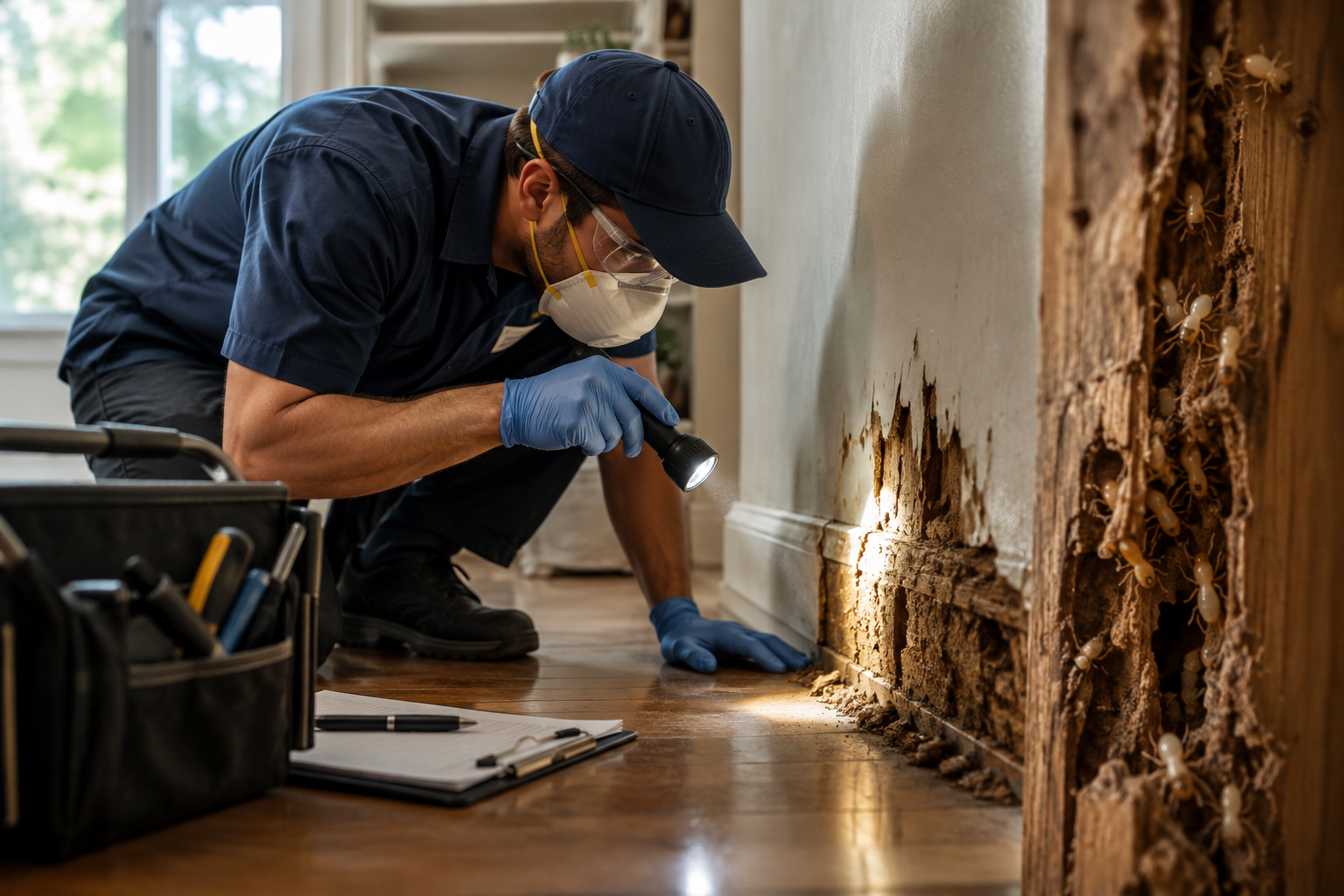
Termite signs include mud tubes along foundation walls or support piers (used to travel between soil and wood while avoiding open air), wood that sounds hollow or papery when tapped, and small, ridged, pellet-shaped droppings called frass resembling fine sawdust near baseboards and window frames.
Carpenter ant signs include piles of coarse, shredded wood shavings — sometimes mixed with bits of dead insects — pushed out of small "kick-out" holes near the nest entrance. Unlike termites, carpenter ants don't eat the wood they remove, so what you find is displaced material, not digested waste. You may also hear a faint rustling inside walls at night as workers move through their galleries.
Drywall Signs of Carpenter Ants
Carpenter ants frequently nest inside wall cavities behind drywall, particularly around window sills, door frames, bathroom plumbing, and any spot with a history of moisture damage.
Watch for small, clean-edged holes in the drywall with fine wood shavings collecting just below them, a faint rustling or crackling sound inside the wall (most noticeable in quiet rooms at night), soft or slightly bulging drywall near plumbing fixtures, and winged ants appearing indoors in late spring often a sign an established colony is producing new reproductives.
The visible entry point is usually small, but the colony behind it can be much larger, which is why a wall-cavity problem is worth inspecting rather than treating with a surface spray alone.
What Month Are Carpenter Ants Most Active?
In the Toronto and GTA climate, carpenter ants become most active from May through July, when warming temperatures drive foraging workers outdoors in search of food and moisture, and mature colonies produce winged swarmers to start new nests.
Activity continues at a lower level through August and September before workers retreat deeper into the nest as temperatures drop.
Termite swarms follow a similar seasonal pattern, typically appearing from late spring into summer, though subterranean termite colonies stay active underground and inside structures year-round wherever conditions stay warm and moist enough including heated basements through winter.
What is the Difference Between Carpenter Ants vs Pavement Ants
Carpenter ants aren't the only large black ant homeowners find around Toronto properties. Pavement ants small, dark brown to black ants commonly seen nesting under sidewalk slabs, driveways, and foundation cracks are frequently mistaken for carpenter ants, but the two are different problems.
Pavement ants are much smaller (2.5 to 4 mm), have a grooved head and thorax, and do not damage wood they nest in soil beneath pavement and occasionally wander indoors for food.
Carpenter ants are significantly larger, nest inside wood, and can cause structural damage over time. Small ants along sidewalk cracks with tiny dirt mounds are most likely pavement ants — a nuisance, not a wood-destroying pest. Large black ants with wood shavings nearby should be treated as a carpenter ant concern and inspected.
Should I Get Rid of Carpenter Ants?
Yes. While carpenter ants don't destroy wood as quickly as termites, an established colony doesn't stay small it grows over multiple seasons, and mature colonies often produce satellite nests inside the same structure, expanding the damage beyond the original entry point.
Left untreated, ongoing tunnelling can weaken window frames, door frames, sills, and structural framing lumber, particularly where moisture problems already exist.
Carpenter ants are also a useful early warning sign: their presence often points to a leaking roof, damaged flashing, or poor drainage that will keep attracting pests even after the ants themselves are eliminated.
Getting rid of them isn't just about the ants it's about catching the underlying moisture problem before it becomes expensive.
What Kills Carpenter Ants Immediately?
This is one of the most searched questions we hear, and it deserves an honest answer: nothing sold over the counter kills a carpenter ant colony "immediately," and products promising instant results by killing visible workers on contact usually make the problem worse.
Contact sprays only eliminate the ants you can see; the nest which can hold thousands of workers plus a queen stays untouched and often relocates deeper into the wall, making it harder to find later.
What actually works is a slow-acting bait that workers carry back to the nest and share with the rest of the colony, including the queen. It's slower by design (often one to two weeks for full elimination), but it's the only approach that resolves the infestation at its source rather than just knocking back visible activity.
A same-day professional response with targeted baiting will get you a faster real-world result than any store-bought spray.
How to Treat for Carpenter Ants and Termites
Because these are two different pests with two different biologies, they require different treatment approaches a generic "wood pest" spray will not resolve either one.
Carpenter ant treatment starts with locating the nest, or nests, since colonies often split into a main nest and satellite nests. Targeted bait and residual treatments are then applied at entry points and along foraging trails, letting workers carry the bait back to eliminate the colony at its source, followed by a perimeter barrier to prevent new colonies from moving in.
Termite treatment typically combines several methods depending on the extent of the infestation: a liquid termiticide barrier around the foundation, bait stations around the perimeter for ongoing colony elimination, foam injection into wall cavities or affected wood, and heat treatment a chemical-free option that raises affected areas to a temperature fatal to termites. Addressing moisture and wood-to-soil contact is also a critical part of any termite plan, since damp wood is what attracts termites in the first place.
In both cases, an accurate inspection has to come before treatment misidentifying the pest means applying the wrong method while the damage continues.
Conclusion:
Toronto and the surrounding GTA present specific conditions that make professional identification especially important. Eastern subterranean termites are established in Toronto, Mississauga, Vaughan, and most Ontario home insurance policies do not cover termite damage making early detection the only real protection homeowners have. Older neighbourhoods with wood-to-soil contact, along with the region's humid summers, favour both pests moving in undetected. Check your property against our full breakdown of the signs of a termite infestation in Toronto before booking an inspection.
If you're searching for termite control in Toronto or carpenter ant control in Toronto, working with a licensed local team matters, since telling the two pests apart correctly is the difference between a small bait treatment and a much larger repair bill down the road At Nomore Pest our technicians provide free inspections, same-day response across the GTA, and treatment plans built around Ontario-approved methods — from liquid termiticide and heat treatment to targeted ant baiting systems. View our full carpenter ant control services or termite control and treatment services, or see how we support your area on our Toronto pest control services page.
Frequently asked questions
Can carpenter ants and termites infest the same house?
Yes. It's uncommon but not impossible, especially in older homes with long-standing moisture problems, since damp, damaged wood attracts both pests independently. A professional inspection will identify whether one, both, or neither is present.
Are carpenter ants dangerous to humans?
No. Carpenter ants don't carry disease and rarely bite people, though large workers can deliver a pinch if handled directly. The real risk is to your property, not your health.
How much does carpenter ant or termite treatment cost in Toronto?
Costs vary depending on the size of the property, extent of the infestation, and treatment method required. The most reliable way to get an accurate number is a free, no-obligation inspection, since pricing based on a phone description alone is rarely accurate.
Do I need a professional, or can I treat this myself?
For small, easily accessible pavement ant activity, DIY options can help. For carpenter ants inside walls or any confirmed termite activity, professional treatment is recommended — misapplied DIY products often scatter the colony instead of eliminating it, making later professional treatment harder.
Got a pest problem? Don't wait.
Book a professional inspection across Toronto & the GTA and get peace of mind, backed by a licensed & insured local team.
Or email us at info@nomorepest.ca · Toronto & the GTA