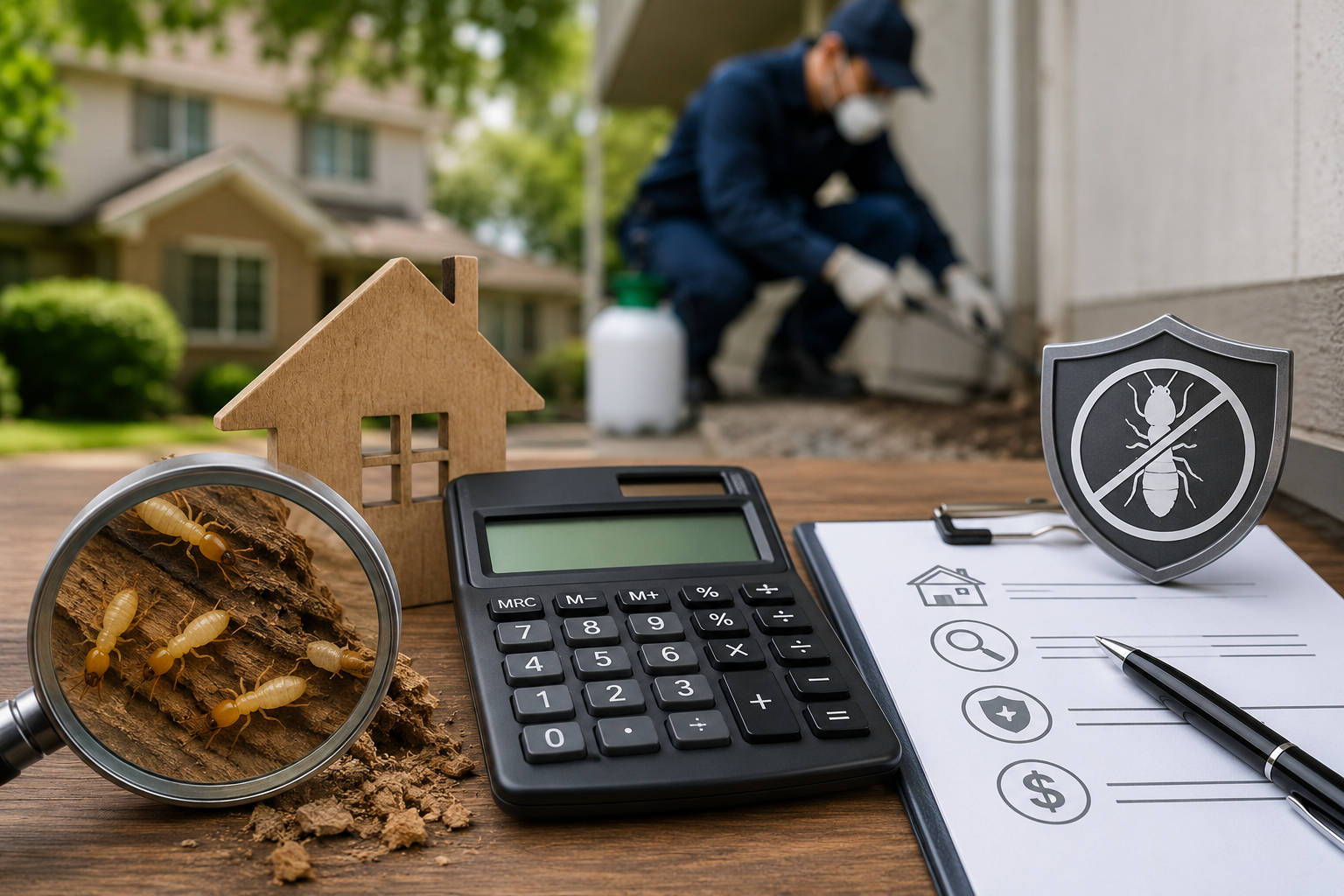
If you have found termite activity in your home, the first question is almost always the same: how much a termite treatment cost is going to be, and whether it is the kind of bill you can absorb this month.
The honest answer is that it varies more than almost any other pest control job. Published Canadian cost guides put termite work anywhere from under $200 for a small localised job to well over $3,000 for a full structural programme.
That range is not vagueness for its own sake. Termite pricing depends on how the colony is reaching your home, how far it has spread, and which treatment method the situation actually requires.
This guide breaks down what Toronto homeowners can realistically expect to pay, what drives a quote up or down, and how to compare estimates without getting caught out by the things they leave off.
How Much Does Termite Treatment Cost in Toronto?
For most Toronto homes, termite treatment falls somewhere between $300 and $3,500. Severe or long-established infestations involving structural work can run higher.
Canadian pricing guides published in 2026 put termite programmes across the country in the range of roughly $185 to $1,530, while Toronto-specific guides quote $1,000 to $3,000 for full treatment. Complex jobs are quoted higher again.
Here is how that breaks down by the type of work involved:
| Service | Typical Toronto range |
| Termite inspection | $75 – $250 (often credited against treatment) |
| Spot or localised treatment | $300 – $800 |
| Liquid barrier (full perimeter) | $1,500 – $3,500 |
| Bait station system (installation) | $1,200 – $3,000 |
| Annual bait monitoring | $300 – $600 per year |
| Severe or structural infestation | $3,500+ |
These are industry ranges drawn from published Canadian cost data, not a fixed price list. No reputable company can quote your home accurately without inspecting it first.
What You Are Actually Paying For
Understanding the treatment types makes the numbers make sense. Two quotes that look wildly different are often quoting completely different work.
The inspection
A termite inspection usually costs between $75 and $250 in the GTA. Many companies waive or credit this fee if you book treatment at the same visit.
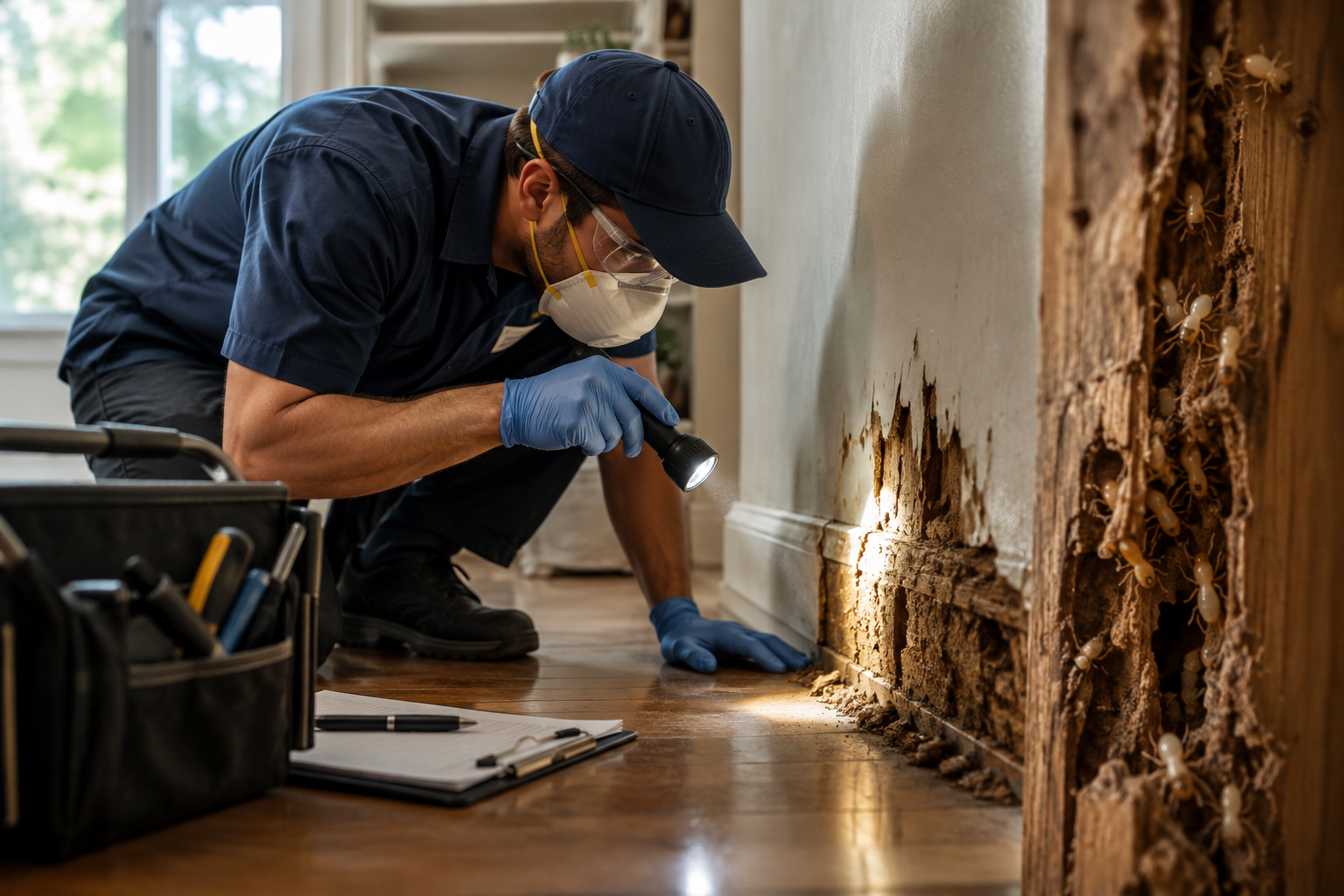
The inspection is not a formality. A technician traces mud tubes, sounds the structural wood, checks crawl spaces and sill plates, and looks for the moisture and soil contact that let termites in.
If you are not sure whether what you have found is termite work at all, our guide to identifying termite mud tubes covers the most common evidence homeowners spot first.
Spot and localised treatment
Where activity is confined to one area — a single porch post, one section of sill plate, a small run of mud tubes — a targeted treatment may be enough.
This typically runs $300 to $800 and is the cheapest professional option. It is also the one most likely to be recommended when a problem is caught early.
The limitation is real, though. Spot treatment addresses what has been found. It does not guarantee the colony is not feeding somewhere else on the same structure.
Liquid barrier treatment
A liquid barrier involves applying termiticide into the soil around the foundation, creating a treated zone that termites cannot cross to reach the building.
For a typical Toronto home this runs $1,500 to $3,500. The work often requires trenching around the perimeter and drilling through concrete where patios, walkways or garage slabs meet the foundation.
That drilling is why quotes vary so much between properties. A house with open soil on all four sides is far cheaper to treat than one boxed in by hardscaping.
Bait station systems
Bait systems work differently. Monitoring stations are installed in the soil around the property, and once termites find them, a slow-acting bait is introduced that workers carry back to the colony.
Installation generally costs $1,200 to $3,000, with annual monitoring of $300 to $600 after that. The trade-off is time — colony elimination through baiting takes months rather than a single visit.
Baiting is often preferred where drilling would be disruptive, or where a property needs ongoing protection rather than a one-time treatment. Which method suits your home is something a technician determines during a termite inspection, not something you should have to choose blind.
7 Factors That Change Your Quote
Two houses on the same street can receive quotes that differ by thousands. These are the variables doing the work:
- Property size and perimeter length. Liquid treatment is priced largely by linear footage of foundation. A larger footprint means more product and more labour.
- How far activity has spread. One affected joist is a different job from activity across a whole basement.
- Foundation type and access. Rubble and stone foundations common in older Toronto homes are harder to treat than poured concrete.
- Hardscaping around the house. Patios, driveways and walkways abutting the foundation mean drilling, and drilling means labour.
- Crawl space conditions. Low, damp or cluttered crawl spaces slow the work considerably.
- Treatment method. Baiting and liquid barriers have different cost structures and different timelines.
- Whether monitoring is included. Some quotes cover follow-up visits; others charge per visit. This is the single most common source of unexpected cost.
Labour makes up roughly half to two-thirds of most pest control quotes. The termiticide itself is a comparatively small part of the bill.
Why Toronto Costs More Than the Rest of Ontario
GTA pricing runs consistently higher than smaller Ontario markets, typically by 10 to 25 percent. Canadian cost guides note that the same scope of work can cost a few hundred dollars more in Toronto than in a mid-sized city.
The reasons are ordinary business ones: higher labour rates, higher commercial rents, and higher operating costs across the board.
There is also a housing stock factor specific to this city. Older neighbourhoods across Toronto have the pre-1960 construction, rubble foundations and wood-to-soil contact that make termite work more involved, and termite activity across Toronto is concentrated in exactly those areas.
One practical warning when researching prices online. Searching for termite costs in "Ontario" frequently returns results for Ontario, California — a completely different market with a different termite species. Check that any figures you find are Canadian.
How to Get an Accurate Termite Treatment Quote
Termite quotes are difficult to compare because companies scope the work differently. These five steps make the comparison meaningful.
- Document what you have found. Photograph any mud tubes, damaged wood or winged insects, and note where and when you found them. Do not scrape anything away — it is the evidence a technician needs.
- Book an inspection before requesting prices. Any quote given over the phone without an inspection is a guess. Ask whether the inspection fee is credited if you proceed.
- Ask which treatment method is being quoted. A liquid barrier quote and a bait system quote are not comparable on price alone. Make sure you know which one you are looking at.
- Confirm what the price includes. Ask directly whether follow-up visits, monitoring and re-treatment are covered, or billed separately. Get the answer in writing.
- Verify licensing and the warranty. Structural extermination in Ontario requires a licensed exterminator. Ask what warranty is offered and what would void it.
Three written quotes is a reasonable benchmark. If one is dramatically cheaper, the usual explanation is a narrower scope rather than a better deal.
The Cost of Waiting
Termite treatment is expensive. Termite damage is worse.
Eastern subterranean termites — Reticulitermes flavipes, the only termite species established in Ontario — feed continuously on structural wood. Colonies can number in the hundreds of thousands and work out of sight for years.
By the time damage is visible in floors, joists or framing, repair work is carpentry rather than pest control. Structural repairs regularly run into five figures, and that is before treatment costs are added.
There is also a resale consideration. Termite activity is material information in an Ontario property transaction, and unresolved damage discovered during a buyer's inspection can cost far more in a renegotiated price than treatment would have.
This is why early identification matters so much. Knowing the signs of a termite infestation is what keeps a job in the $300 range instead of the $3,000 one.
Is Termite Damage Covered by Insurance in Ontario?
Generally, no. Canadian home insurance policies typically exclude damage caused by insects and vermin, on the basis that infestations are considered preventable through maintenance.
Insurers treat termite damage as a gradual problem rather than a sudden event, and gradual damage sits outside standard coverage.
Some policies may cover resulting damage in narrow circumstances — if termite activity causes a sudden structural collapse, for instance. That is the exception, not the rule.
Check your own policy wording rather than assuming either way, and treat the treatment cost as one you will be paying yourself.
Conclusion:
The ranges in this guide are a starting point, not a quote. What you pay depends on your foundation, your perimeter, how far activity has spread and which method the situation calls for — and none of that can be assessed from a phone call.
If you are seeing mud tubes, damaged wood or winged insects, the useful next step is an inspection that tells you what you are actually dealing with.
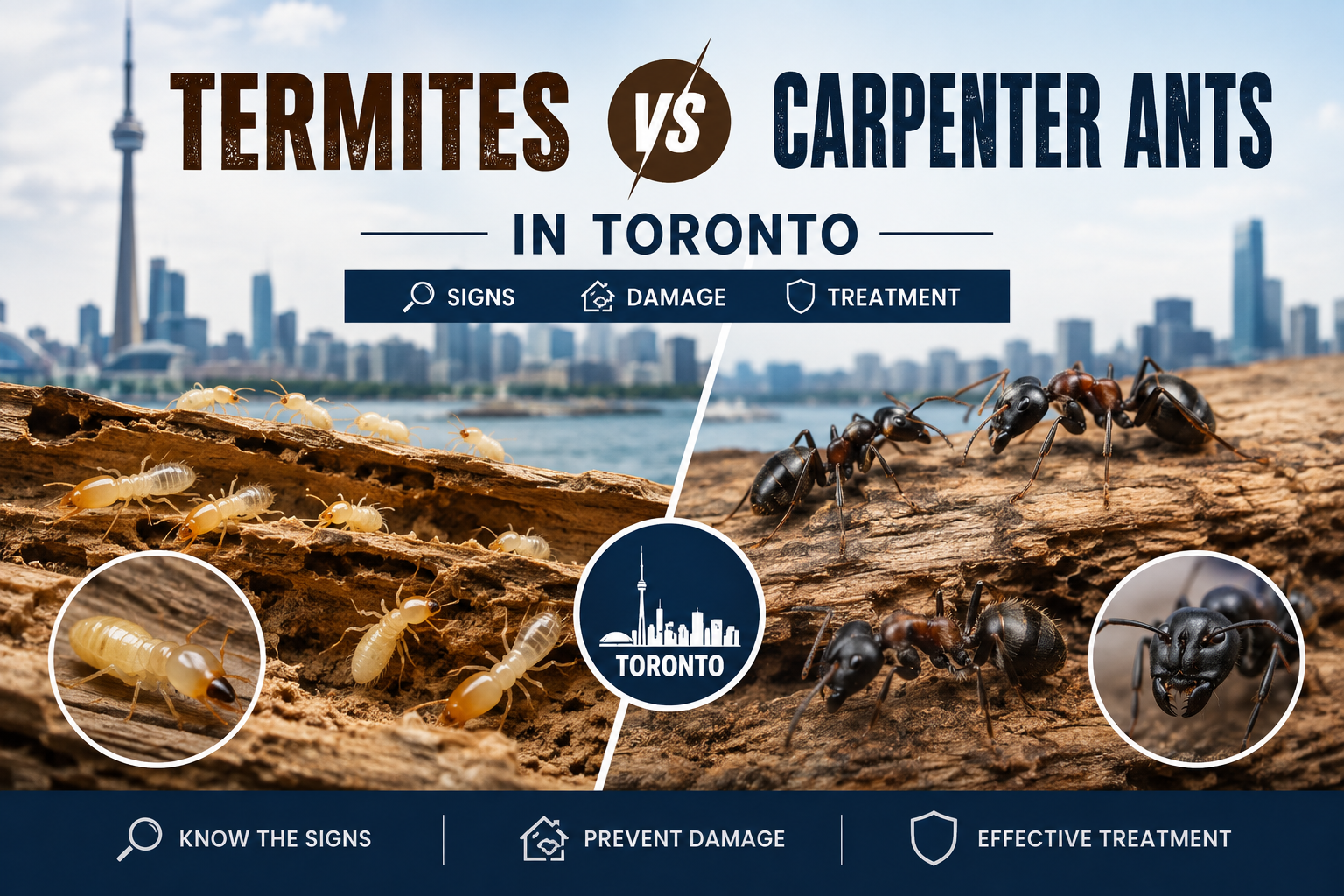
If it turns out to be carpenter ants rather than termites, the difference between the two changes both the treatment and the cost considerably.
Nomore Pest inspects and treats termite activity across Toronto and the GTA. We will tell you what we find, explain which treatment the property needs and why, and give you a written quote that shows what is included — before any work starts.
Book a termite inspection with Nomore Pest and get a number based on your home rather than an average.
Frequently asked questions
How much does termite treatment cost in Toronto?
Most Toronto homes fall between $300 and $3,500 depending on the method and how far activity has spread. A localised spot treatment sits at the lower end, a full perimeter liquid barrier at the upper end, and severe structural infestations can exceed that range.
How much does a termite inspection cost?
A termite inspection in the GTA typically costs between $75 and $250. Many companies credit or waive the fee if you proceed with treatment at the same visit, so ask before booking.
Why do termite quotes vary so much between companies?
Usually because they are quoting different work. One may be pricing a spot treatment while another prices a full perimeter barrier. Scope, follow-up visits and warranty terms differ, so always compare what is included rather than the headline number.
Is bait or liquid treatment cheaper?
Spot and liquid treatments cost more upfront but resolve faster. Bait systems have a lower entry cost with ongoing annual monitoring of $300 to $600, so over several years the totals can be similar. The right choice depends on the property, not the price.
Does home insurance cover termite treatment in Ontario?
Generally no. Canadian policies typically exclude insect and vermin damage because infestations are treated as preventable through maintenance rather than sudden events. Check your specific policy wording, but plan on paying for treatment yourself.
Is it cheaper to treat termites early?
Significantly. Activity caught early may need only a targeted treatment in the $300 to $800 range. Once damage reaches structural wood, the work becomes carpentry as well as pest control, and repair costs commonly run into five figures.
Got a pest problem? Don't wait.
Book a professional inspection across Toronto & the GTA and get peace of mind, backed by a licensed & insured local team.
Or email us at info@nomorepest.ca · Toronto & the GTA